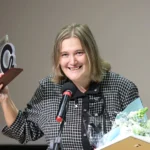
Olga Valenteva is a Russian writer, author of science fiction and fantasy. The writer admits that she does not like to talk about herself, preferring to listen to her interlocutors, so almost nothing is known about her childhood, education, and personal life. But she gave an exclusive interview to the portal ‘Futurating’. We are happy to share it with you.
— Olga, what is your ideal world of the future?
An ideal world is something that cannot exist. Our world is beautiful in its imperfection. To say what the future will be like in 30-50 years is, in principle, impossible for a person. Well, of course, one can dream, speculate. It seems to me that it should be more stable, more balanced. I would like every person to feel confident about the future, knowing how to achieve their goals.
Now we are faced with the fact that a person wants to become an actor or a writer. They say to themselves: ‘No, that’s not serious, and I don’t know how to do it.’ But we need to make it so that they can do it, and so that any profession is in demand.
— What will the world be like?
I think it will be mostly robotic. We already see this today. And 30-50 years later, we will have flying cars, we will have public transport without drivers. Technological progress will leap far ahead. I would like that to happen in medicine, so that we conquer the diseases that are destroying humanity today, so that human life expectancy increases. After all, we live too short a time. Not only ours, but also that of our smaller brothers, because all my friends are following the vaccine for dogs to increase their lifespan. And I want to believe that in 30-40 years this will be possible. That it will be possible to preserve human memory. So that it doesn’t die, for example, with the person, but is stored in some way.
— What needs to be done for this?
— Work. Patience and work will grind everything down. That is, if a person persistently strives for their goal, if they work hard at it, then any future can become reality. I recently came across an article about how a boy invented a prosthetic for his brother. If a person truly desires something, if it is such a big dream for them, then they will strive for it, they will be able to achieve even what they initially thought they were incapable of. In our remote areas, there are many people who do not have access to large-scale programs, cannot make themselves heard loudly. And their talent dies at this stage. We need to identify such people, give them a chance to develop, invest money in our own science, in those scientists who are already showing good results today. Search for them, find them, and make sure the state invests in them, so that they later invest in the state.
— What are the obstacles to such a future?
Well, there are different barriers, actually. Technological, but that’s for the moment; later they will fall. I don’t think that any cultural barriers prevent us from moving towards a bright future; on the contrary. The real problem is that it’s hard to plan even for tomorrow, let alone estimate what your life will be like in a month, in a year, and whether it will be at all. We want stability and self-realization.
— What is the mission of science fiction in creating the future?
— The mission of science fiction writers has always been very great. Yes, let’s remember Jules Verne, let’s remember Alexander Belyaev. They are my favorites, so to speak, whose works first featured such scientific discoveries that did not yet exist in nature, but they happened on the pages of books. As a science fiction writer, I believe that what we create today in our books, even if it often seems incredible even to ourselves, it may well awaken someone’s inspiration, not creative, but technological inspiration. And scientists will say, well, if it’s possible in a book, how does it work? Let’s do it.
But if we talk about my books, I mainly draw attention to some societal problems, such as ‘loneliness in a crowd’. Why? So that people do not remain alone with their problems. Shaping a collective image of the desired future, yes, it is a powerful stimulus, because if many people are inspired by a book and constantly run its plot through their minds, it will become truly possible. I believe in the power of thought, and I believe that we can transform our future with the power of thought.
— What can every person do in daily life to bring a bright future closer?
Be kinder. In fact, human egoism is devouring us. We are becoming angrier at each other in some ways. For our future to be bright, we must not cling to the past. We must build the future as we would like to see it. Even not for ourselves, but for our children. Because every mother, every father wants the best for their child. What kind of world would you like to see for your child? Build it exactly like that.
Photo from open sources
Comments (0)