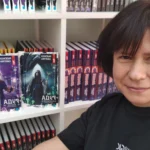
Nadezhda Ozhigina is a contemporary Russian writer known for her works in the genres of fantasy and magical realism. Her books, such as «The Seventh Sister» and «The Path Between,» are distinguished by their deep atmosphere and vivid characters. Nadezhda also works as a designer, which helps her create vibrant worlds. The platform «Futurating» asked: why do science fiction writers often write about the present day, and in a negative light? And their future is completely bleak. Nadezhda Ozhigina answered honestly and impartially.
Science fiction today often doesn’t predict the future but describes the anxieties of the present. Is this good or bad? What is more important for shaping cultural codes — searching for new utopias or reflecting on what we have already lost?
— Progress is such that the boldest ideas of science fiction writers can already become history by the time the text is published. We can’t keep up with the future, so we can’t design it at any distant horizon. What remains is a reassessment of the present, reflection on once-lost meanings, and a search in the future for those utopias created by science fiction writers of the past. None of the utopian scenarios of the past have justified themselves, so in modern science fiction there is a desire to revive them in new realities — that is, old utopias in a new guise. Well, in general, this is a stage of development not only for science fiction but for all literature.
Technologies are accelerating, and cultural narratives are becoming shorter and more fragmented. What will happen to large novels in a world where attention is the main value? Will heroes who unite everyone appear, or will everyone live in their own story?
— The approach to creating large-scale works changes from year to year. To begin with, Western algorithms imposed on novice authors by various creative writing schools intervened: «Write simpler, cut, don’t use participial phrases.» The trend toward simplification sharply reduced the figurative richness of our language, then came the so-called clip thinking with its associated problems. To hold the attention of young readers, we have to shorten sentences, simplify meanings and plots overall. I can predict a return of interest in the form of the short story and the «frame» novel, but that’s not certain. Large-form works and even seriality are still interesting to everyone, so I don’t see a big problem.
As for creating a universal hero who appeals to all generations — that is unlikely to succeed, at least not by deliberately cultivating one. Such a character is a bespoke product, dependent on many factors. But generations now differ so much in perception due to technological progress that chasing generalization is futile and silly. We will stew in that sector of fantasy literature that meets personal demands. We are learning in advance to individualize the capsule space and virtual realities of life.
Neural networks already write texts, imitating styles and plots. Is the role of the writer changing? What will remain for humans in designing the future through culture?
— I think in the more or less foreseeable future, the writer will remain an engineer, if they remain a writer. A symbiosis of creativity is possible but limited. The more internal constraints a writer sets for themselves, the more ideas and meanings they bring to their texts. Breakthroughs in literature with the help of AI are not yet possible — only the acceleration of routine processes for making money. Because popular narratives and tropes are used, and we learn from a database created by humans, taking their experience — both positive and negative. I naively and optimistically believe in the human mind, that creativity and imagination leading beyond the horizon will remain with humans. AI will take on the function of developing and calculating human ideas. Naive, but I am a science fiction writer. I can dream.
Previously, science fiction was built on external conflicts — man vs. machine, individual vs. system. Now boundaries are blurring, the main struggle is turning inward. How will this change cultural codes, heroes, and what we consider happiness?
— I find it difficult to answer the fourth question. I’m not sure the vector is shifting that much. It goes deep into a person, yes, into their mind and inner world. But the main tropes remain: man versus machine, man versus system. It’s just that the machine and system are now placed inside the human body — that is, it’s not the conflict itself that changes, but the positioning. The tasks and goals remain the same, and thus the ways of resolving them: acceptance, protest, sacrifice for the common good, heroism, or complete submission. As long as people themselves, with the development of technology, do not change externally and internally — that is, until we get in reality those very symbionts with built-in brain navigators and social networks, who will perceive reality differently — the main conflicts will remain human.
They say that the world increasingly lives according to the laws of scripts — from social networks to politics. What is the main task of science fiction now: to offer options for salvation or to teach people not to trust ready-made scripts? And in this situation, what becomes the main function of a writer?
— The main function of a writer remains the same — to show and teach: how it can be, how it cannot be, how it could have been, why nothing good came of it. It seems to me that now the task of a writer is to forecast the future with a large dose of positivity. All the terrible scenarios of the past are coming true here and now — in science, politics, culture. Let’s all dream together about something good and bright, so that it comes true in the future. Personally, as a writer, I don’t know how to do that. I try, I learn, but I call upon every writer to think about something positive.
Photo from open sources
Comments (0)