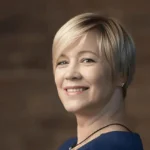
Zhanna Bochmanova is a great friend of the «Futurating» platform, a contemporary Russian writer, author of books for children and adults. A native of St. Petersburg, she graduated from the Leningrad State Institute of Culture (library faculty). She is a member of the Union of Writers of Russia. Over the course of her career, she has tried many professions, but ultimately focused on writing. In 2015, she completed the literary courses «Master of Text» at the publishing house «Astrel-SPb». She is a participant of Sergey Lukyanenko’s Literary Workshop. She works in different genres: realism, science fiction, detective fiction, children’s prose. She took part in the project «Tomorrow’s Classics: Education through the Word», implemented by the Union of Children’s and Youth Writers with the support of the Presidential Fund for Cultural Initiatives.
And today we will talk with her about the future, science fiction, and children — who will read this science fiction and build this future.
— Let’s start with the main thing: what will happen to books, readers, and writers in the future? For years now, the media has been burying the book industry.
— I think that things will stay the same with books as they always were. And even better. For example, science fiction was popular in the 70s. We all grew up on those books. And modern children will love reading if this science fiction is directed toward the future, that is, if it shows, just like in the 70s, how people go into space, explore other planets, and contact alien intelligence. It motivated us to look to the future and strive for it, and it will do the same for our children. Right now, literature is turned to the past; we just need to turn 180 degrees. I believe that in the future, writers will certainly be smarter, kinder, and more talented than today. They will be raised from childhood, perhaps like musicians or artists, athletes — from an early age. Talented children with a command of words will be selected and gradually nurtured into geniuses, writers of the Russian Land. That’s the kind of future I think awaits us.
— Is science fiction somehow connected to a person’s education?
— Perhaps in the future there won’t be a single unified education program, but it will be shaped taking into account the individual characteristics of each student. And writers will have to compile all this, to encourage children to learn new things. In general, a writer should precisely encourage children, adults, anyone, to learn something new. You read a book, something interests you — and there you are, you’ve grown wiser. A writer’s task is to give the future an optimistic scenario, so there is something to strive for.
— Do you believe in the power of the word of a children’s science fiction writer, where positive thoughts and images from books gradually become reality?
— I can’t speak for the entire writing fraternity, but for me, for example, science fiction literature played a very big role in childhood. I grew up on the books of the Strugatskys, Snegov, Asimov, Bradbury — they gave me a different vision of the world. Science fiction awakens the imagination, especially in a child when they haven’t yet formed as a person. And depending on what kind of books these are — positive, with a good message, or if it’s terrifying horror with an apocalypse — the child’s worldview will be shaped accordingly. By the way, I have a very good attitude towards dystopias and apocalypses as a genre. But, again, they should carry some kind of positive message. Absolutely. The heroes must overcome difficulties, fight enemies, either external or internal, win and still move towards a positive ending. Therefore, the word of a science fiction writer, a writer, plays a big role. I hope this trend doesn’t dry up, that we will truly teach our readers what is good, bright, and eternal.
— Can anyone become a writer?
— Anyone can become a writer. And anyone can write optimistic scenarios. Can it be said that science fiction is the foundation of a happy future for society? I believe that in general, books should not have it written in plain text «what is good, what is bad,» like in Mayakovsky’s poems. Books teach us something, not because the solutions are described directly in the text, but indirectly, through the plot, through the characters, through their development. So, yes, books should reflect the state of society and even slightly anticipate it. The society of the future is a society of justice, creativity, but this should stem from the plot: the reader should draw this conclusion themselves — I want to live like that too! When you read a good science fiction book with an optimistic future, like Efremov’s, for example, you think: «People live so coolly, how did they upgrade themselves so much — there is no envy, greed, or desire to grab more benefits for themselves in them.» So, yes, we must write about the desired future. But again, to write about it, a person must be like that themselves. Well, or strive to become such.
It is impossible to describe kindness, honesty, if you yourself are a thieving swindler. How will you write about it? You simply don’t have it inside you, and all people who observe ethical norms seem like idiots to you. I know a lot of such people who say: «Well, why not take it? It’s lying there unattended. I went and took it.» It doesn’t even occur to them that it’s immoral, dishonest, that you are causing suffering to someone by doing this. So first we ourselves become people of the future, inside ourselves, and only then will it be easy for us to describe an optimistic future. Only that way.
— How can we ensure that the thoughts, dreams, and expectations of ordinary people about the future are heard when designing government strategies, and not depend solely on the opinion of a narrow group of experts?
— In an ideal future, there should be some program, for example, that collects the opinions of all people in the world, some artificial intelligence collects them, summarizes them, and says that such-and-such a percentage of the population wants this, such-and-such a percentage wants that, such-and-such a percentage wants this. Everything is compiled, the average is highlighted, a recommendation is given on how best to do it to satisfy practically everyone. And then decisions are made. Ideally, I think, every opinion should be taken into account and a strategy developed based on that.
— Thank you, Zhanna, see you at «Futurating».
Photo by the author
Comments (0)