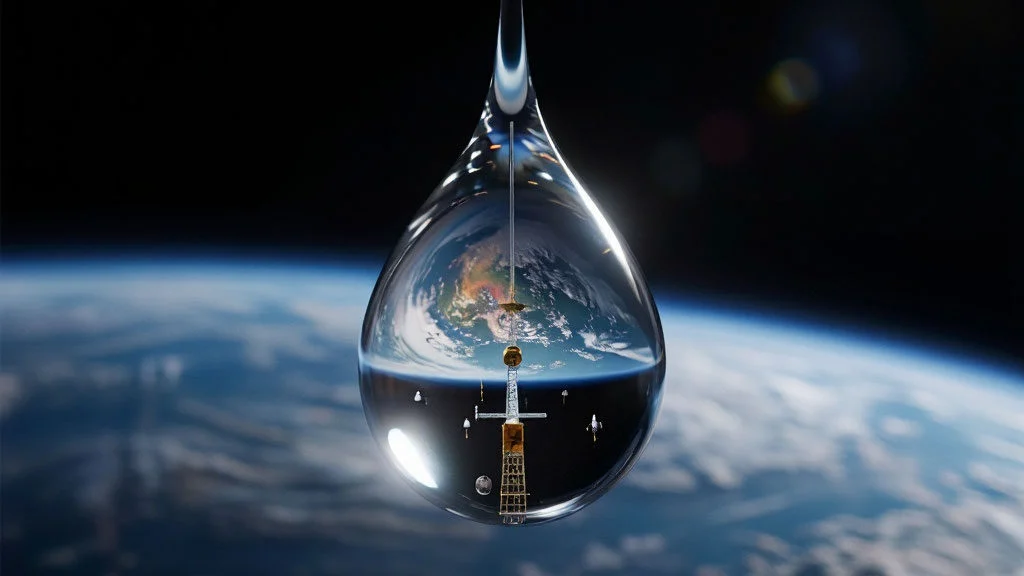

Science fiction writers design the future. Shall we take a look? For example, using Liu Cixin’s trilogy “The Three-Body Problem” we can identify five key futuristic technologies adapted for constructive progress. For each of them, as part of the Futurating platform’s “Living Heritage” project, we created a reflective essay on how this might be. The second invention is eternal materials.
Throughout human history, engineers have struggled with the fact that all metals rust and break. Even the most advanced titanium alloys and graphene gave way under loads above 100 gigapascals. The new strong-interaction materials technology has completely solved this problem. The method works by using a special electromagnetic field to press atoms firmly together, completely disabling their natural repulsion. We bring them to a tiny distance of 10⁻¹⁵ meters. At this level, nuclear attractive forces begin to operate—the very forces that hold protons inside atomic nuclei. The metal is compressed, its density rises to 100 grams per cubic centimeter, and it becomes absolutely strong.
This material cannot be broken, bent, or scratched at all. It is impervious to meteorite impacts at 30 kilometers per second. It does not expand in extreme heat or contract in the icy cold of space, and its surface has a perfect mirror shine and reflects 100% of light. From this super-material, we now make cables for space elevators: a thread just 2 millimeters thick easily holds a 20-ton cabin at geostationary orbit altitude—35,786 kilometers.
In addition, we have finally been able to look inside our planet. Our research probes made of this material pass freely through Earth’s crust and directly into the mantle, where a monstrous pressure of 140 gigapascals reigns. They transmit data in real time, enabling us to predict any earthquake to within one second.








Comments (1)
Если это реализовывать, для космического лифта важна не только прочность, но и удельная прочность и стойкость к радиационному охрупчиванию; сжатие атомов до фемтометров стоит проверить на макрообразцах. Для пилота подошла бы ВСМПО-Ависма: их металлургическая база и опыт с титановыми сплавами дали бы образцы и стенд. Первый шаг — рабочая группа с их инженерами и профильными институтами для проверки устойчивости структуры. А как вы видите охлаждение и защиту от радиации в таком тросе?