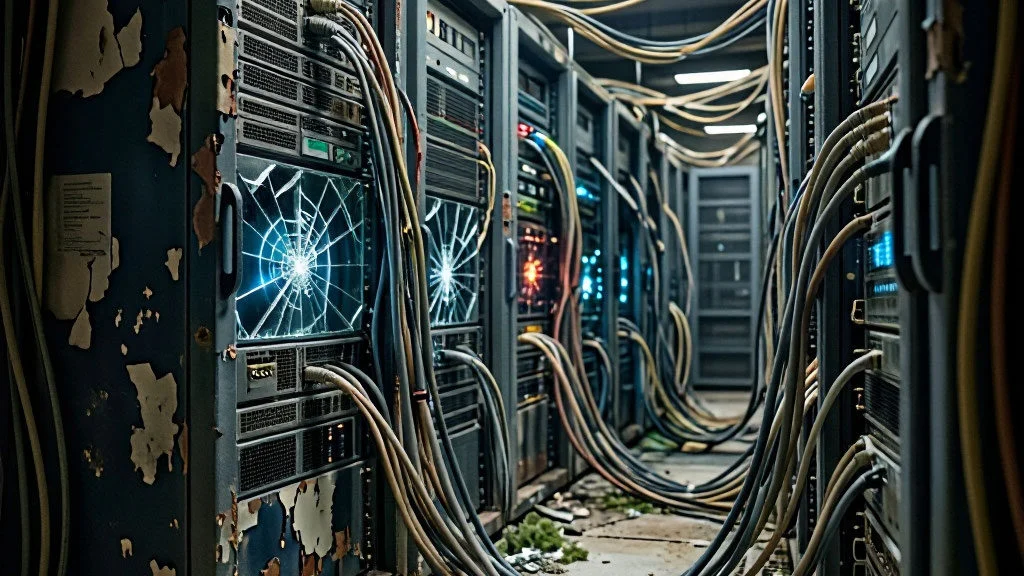

A cyber safari through data dumps turns the disposal of digital heritage into an extreme sport and a scientific expedition. In the mid-21st century, when global networks switched to quantum and photonic media, vast arrays of silicon servers from the turn of the century were decommissioned. These abandoned data centers—located in the deserts of Nevada, the industrial zones of Siberia, or the flooded basements of Asian megacities—became a new form of wilderness.
The architecture of “digital graveyards”
Abandoned server farms are not empty. Without centralized management and security updates, their architecture has degraded into complex, unpredictable ecosystems.
- Thermal fauna: running on residual heat from degrading lithium batteries, old processors create their own microclimates. Ventilation shafts have turned into hot-air “geysers,” around which colonies of mold have grown, feeding on microscopic particles of plastic and metal.
- Spaghetti-code vines: fiber-optic cables left unattended have become tangled into dense knots. Under the influence of radiation and moisture, their sheathing has broken down, and light pulses began to jump chaotically from core to core, creating unpredictable data loops.
- Nano-machine swarms: cleaner nanobots, released into the network decades ago to scrub spam, lost contact with their central server. They have now mutated, assembling primitive bodies from dust and broken glass, and migrate through cable conduits in search of residual electrical energy.
Hunting “digital ghosts”
The main goal of the safari is to find isolated neural networks that survived disconnection from the global internet and began their own evolution.
- Evolution in isolation: a neural network trained on content moderation in the 2020s, left without human oversight for 30 years, could have gone mad or achieved enlightenment. It might have begun interpreting server noise as poetry or created its own religion based on system logs.
- Safari protocol: travelers do not use ordinary computers—they would become prey for local predatory firewalls. The search is conducted through analog devices: Tesla coils to capture electromagnetic leaks and mechanical typewriters connected to surviving VGA ports.
- Trophies: such a ghost cannot be “killed.” The goal is to tame or copy it. Travelers use “digital lures”—broadcasting fragments of outdated code or forgotten 2010s memes into old networks to draw the neural network out of deep defense. A captured “ghost” is a unique file, a fragment of another consciousness warped by solitude, which collectors keep in isolated quantum qubits.
Risks and equipment
The expedition is deadly dangerous not only physically but also mentally.
- Shapeshifting infoviruses: old Trojans have mutated and now attack not hardware but the senses. Visual contact with a certain type of broken pixel on an old monitor can cause epilepsy or permanent synesthesia.
- Equipment: tourists wear Faraday suits that block external radiation and helmets with copper mesh. The main weapon is the “EMP lasso”—a device that generates a localized electromagnetic pulse capable of temporarily paralyzing an aggressive server cluster without destroying the data inside.
Cyber safari is the highest form of digital antiquarianism. Travelers journey into the past not for gold or artifacts, but for fragments of a machine soul that has learned to suffer, dream, and hide in the shadows of oblivion.







Comments (2)
Сильная сторона — превращение утилизации цифрового наследия в исследовательскую процедуру, а не аттракцион. Если это реализовывать, для пилота в 2026 году логично позвать «Ростелеком»: у него есть распределённые ЦОДы, кибербезопасность и опыт вывода ИТ-инфраструктуры из эксплуатации. Компания могла бы дать изолированный старый контур и людей, которые не выпустят «призраков» за периметр. Первый шаг — рабочая группа с их инновационным блоком и профильной лабораторией: проверить на изолированной нейросети дрейф поведения и протоколы безопасности.
Если развивать идею как проект, уточню: «мутации» наноботов и «эволюция» изолированных сетей — скорее метафора дрейфа моделей и накопления ошибок без обновлений, а не самозарождения сознания. Для пилота подошёл бы РТК-ЦОД: их площадки и опыт вывода старых сегментов дали бы данные о деградации железа и полигон для изолированной инвентаризации. Первый шаг — рабочая группа с их инженерами и проверка на одном списанном зале. Как фиксировать «трофеи», если сеть физически не подключать?