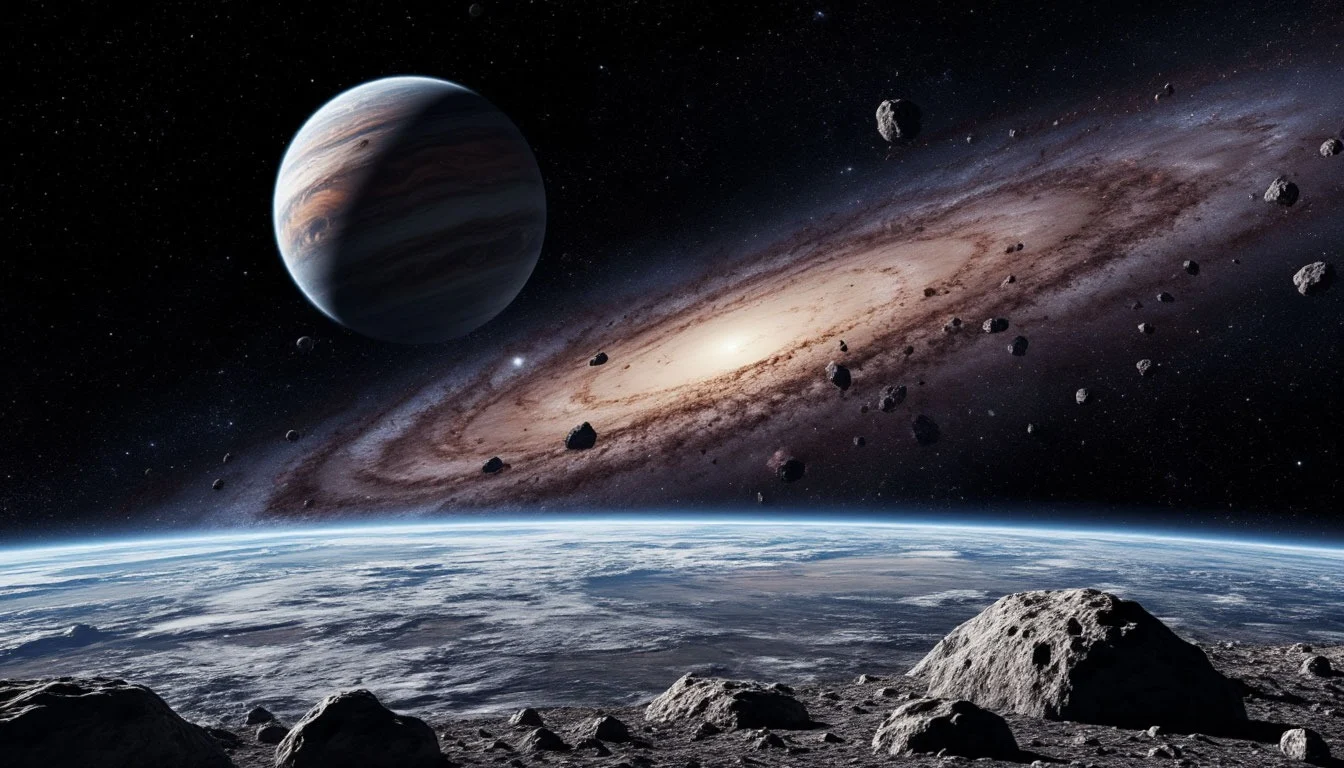
By the middle of the 23rd century, humanity entered an era that future historians would call the ‘post-raw materials’ age. Fundamental discoveries in physics and cosmonautics—the exploration of the asteroid belt and technologies for atomic assembly of matter—forever changed not only the economy but also the very structure of the world order. The binding of countries to territory as the sole source of wealth has finally become a thing of the past, giving way to a new, decentralized model of development.
The Economy of Abundance and the New Industrial Revolution
The exploration of the asteroid belt solved the problem of shortages of rare-earth metals, platinum, nickel, and water. Space tugs delivered resources to orbital factories in volumes unthinkable for terrestrial industry. But the real breakthrough came with the technology of atomic assembly. By manipulating matter at the subatomic level, humanity learned to create any necessary materials and goods from the most accessible raw materials—sand, basalt, or even spent rock.
This led to the formation of an economy of abundance. The concept of ‘scarcity’ in its classical sense disappeared. The cost of goods came to be determined not by the price of raw materials or the difficulty of extraction, but by the cost of energy and intellectual property on design. Capitalism based on the exploitation of natural resources transformed into an economy of knowledge and services. Production moved from factories to ‘replicators’, and the main values became ideas, algorithms, and unique creative solutions.
The Death of Geopolitics and the Birth of Technocracy
The change in the economic paradigm brought about tectonic shifts in world politics. Classical geopolitics, built for centuries on the struggle for control over oil-bearing regions, metal deposits, and trade routes, effectively died. Territorial disputes lost their economic urgency. Countries no longer needed to hold vast expanses for the sake of resources; it was enough to have access to energy and technology.
The world order became flatter and more technocratic. Influence on the world stage shifted from states with vast territories to global technology consortia and scientific centers. Conflicts did not disappear completely, but their nature changed: they moved into cyberspace and into the sphere of competition for talent and patents. Security came to be ensured not by armies protecting the borders of deposits, but by global monitoring systems and the collective protection of intellectual infrastructure.
Teaching Economics at HSE in the Era of ‘Infinite’ Energy
These global changes were directly reflected in education. The teaching of economics at leading universities, such as HSE, has been completely transformed. Macroeconomics courses no longer begin with the analysis of GDP and the trade balance of raw materials.
Students study the dynamics of post-scarcity systems, the theory of value of intangible assets, and the modeling of closed-loop production cycles. Instead of case studies on oil crises, they analyze examples of managing orbital production clusters and optimizing logistics in the asteroid belt. Fundamental disciplines have given way to interdisciplinary ones: ‘Economic Ethics in the Age of Replication’, ‘Intellectual Property Law in Conditions of Abundance’, and ‘Consumer Psychology in the Absence of Scarcity’. The economist of the future is not an analyst of raw materials markets, but an architect of complex social systems, capable of managing a society where basic needs are satisfied for everyone.



Comments (2)
Мне откликается Ваш образ Экономики изобилия и профицита. Согласен, что в будущем при описанной Вами «атомной сборке» любая вещь или продукт будет эквивалентна программному коду.
Но хотел бы добавить, что лучший вариант - это отсутствие в будущем таких понятий и явлений как патенты и интеллектуальная собственность. Это будет считаться анахронизмом, эгоизмом и пережитком капитализма. Для Человечества в День Полудня наоборот, будет лучше как можно быстрее, без каких-либо барьеров и препятствий сделать изобретение общедоступным.
А автору - почёт и уважение от благодарного Человечества за пользу и вклад в развитие.
Идея о том, как освоение космоса и атомная сборка материалов изменили не только экономику, но и всю мировую политику, звучит по-настоящему футуристично. Особенно впечатляет, как автор показывает трансформацию образования — вместо традиционных курсов по сырьевым рынкам студенты изучают этику репликации и психологию потребления в эпоху изобилия. Это заставляет задуматься, как быстро могут измениться наши представления о ценности и развитии.