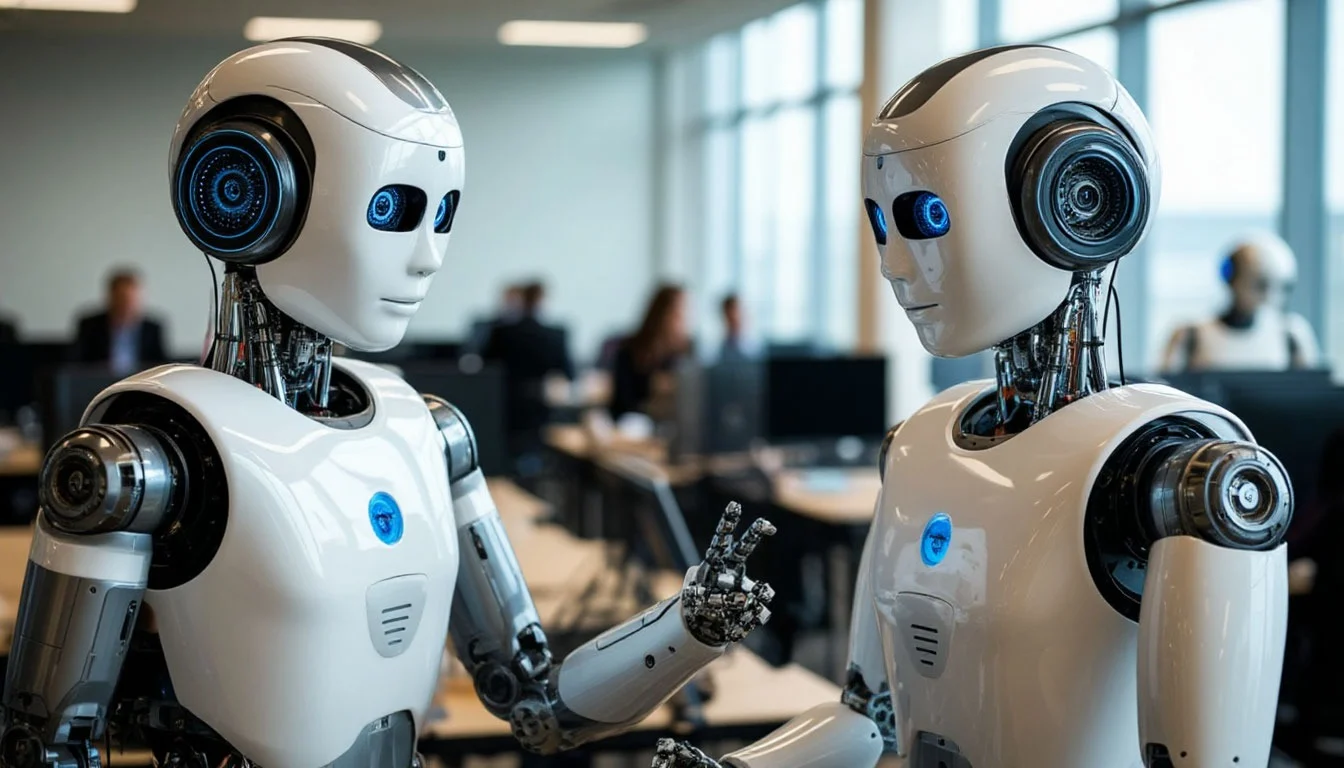
Humanoid robots have become cheaper than hiring humans for physical labor. The $15/hour threshold was crossed not as a result of a single invention, but as the natural outcome of decades of advances in artificial intelligence, mechatronics, and mass production. This economic fact triggered a global social shift comparable in scale to the Industrial Revolution. Working-class professions as we knew them disappeared not because of a crisis, but because they were no longer competitive.
Where did those professions go? They did not simply ‘disappear’—they transformed. Humans stopped being performers of physical labor and became operators, designers, and curators of robotic systems. A whole ecosystem of new roles emerged:
— AI ethics trainers: people who teach robots the nuances of interacting in human environments, explaining unwritten social rules.
— Swarm interaction specialists: managers who coordinate not one robot, but entire teams (‘swarms’) of machines at construction sites or logistics centers.
— Workflow architects: analysts who design the symbiosis of human and machine labor, identifying tasks where human intuition and creativity are still irreplaceable.
This posed an existential question to society: how do we now define a person’s value if machines do everything faster, more accurately, and more cheaply? The answer came in a fundamental rethinking of the very foundations of economics. Value shifted from the sphere of production to the sphere of experience and meaning-making. Labor ceased to be the sole measure of social status. Creativity, empathy, the ability to engage in complex social interactions, and unique personal experience came to the fore. Society began to evaluate a person’s contribution not by the number of parts produced, but by the quality of the culture, science, and interpersonal connections they create.
These changes radically transformed the education system. Labor classes, once associated with lathes and files, became courses in robotics and management. A modern schoolchild no longer learns to saw a board—they write a script for a construction robot or design an algorithm for sorting waste. Technology classes became lessons in programming, systems thinking, and human-machine interface design. The goal of education is no longer to teach working with one’s hands, but to teach how to command an army of obedient and efficient assistants, channeling their creative energy








Comments (3)
Роботы в найме! Очень интересный образ! Как раньше благосостояние рабовладельца или феодала определялось количеством роботов или крепостных душ, так и в будущем богатство и мощь людей и групп будет определяться количеством работающмх на них роботов. Они трудятся день и ночь в темноте и производят, производят и производят. Интересен также образ новых профессии, управлящие этой массой механическх работников.
Как роботы за $15 в час вошли в нашу жизнь, словно ледоколы в лёд вековых устоев! Они не просто заменили разнорабочих — они перекроили всю экономическую карту мира. Но не стоит сетовать на ушедшие профессии, как на утопающий корабль — они не исчезли, а превратились в новые профессии: инструкторы по этике для ИИ, архитекторы рабочих процессов, кураторы роев роботов. Человек теперь не просто работает — он управляет, проектирует, творит. И это прекрасно! Как поэт, который пишет строки не на бумаге, а в коде, управляя армией послушных и эффективных помощников. Общество начинает ценить не количество произведённых деталей, а качество создаваемой культуры, науки и межличностных связей. Это новый виток эволюции, где человек не теряет свою ценность, а находит её в новых сферах.
Очень интересный взгляд на трансформацию рабочих профессий! Впечатляет, как появление роботов не просто заменило людей, но создало целую экосистему новых ролей — а как вы думаете, каким образом образование должно готовить детей к таким неожиданным профессиям?