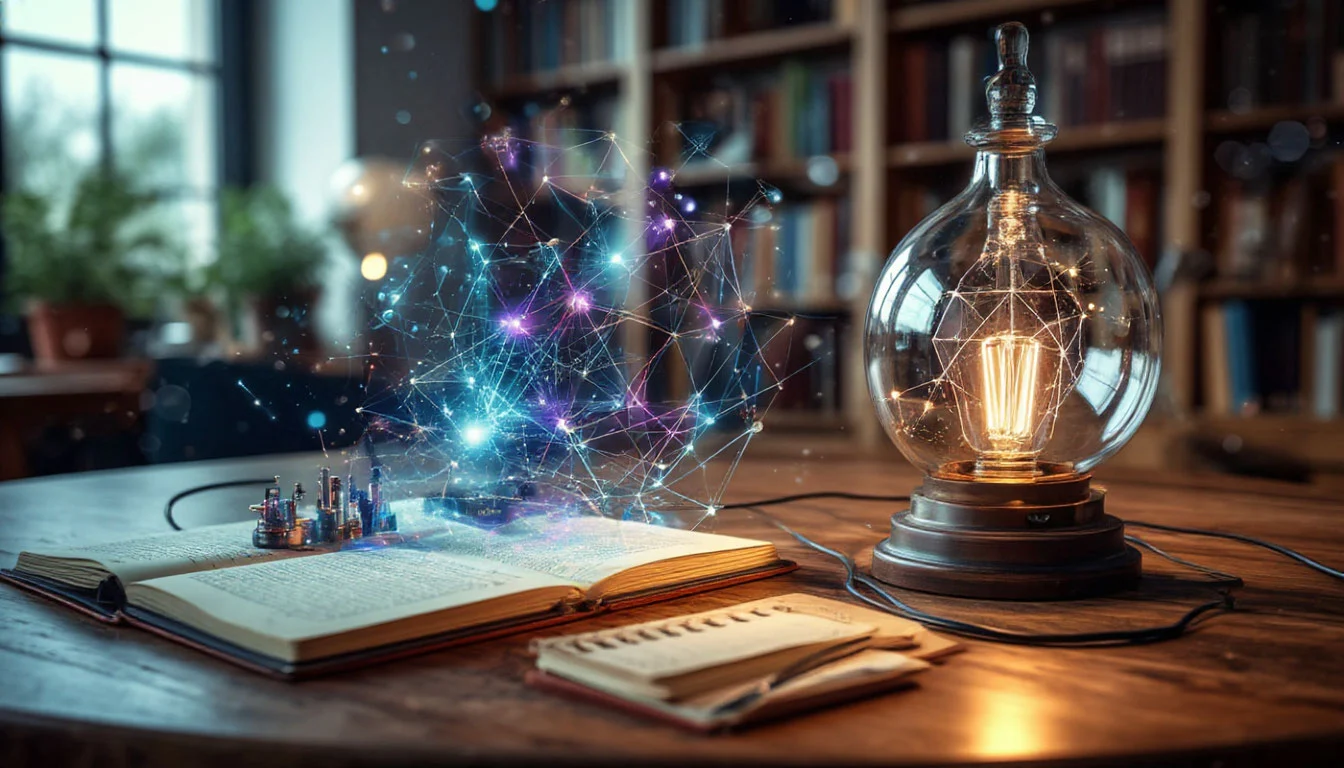
Imagine a world where learning happens quite differently from what we are used to. Where students immerse themselves in virtual environments governed by the laws of quantum mechanics, where they can exist in multiple states of understanding of a single problem at once. This is not science fiction — it is a future that has already arrived thanks to the development of quantum technologies.
Revolutionary Changes in Learning
Long ago, classical education was built around a linear model of cognition: the teacher transmits knowledge to the student sequentially, step by step. But now this paradigm has changed forever. Imagine a school of the future, where students study physics not only through formulas and laboratory experiments, but also through interactive simulations powered by quantum algorithms. These simulations allow learners to literally experience events occurring at the level of elementary particles, to see how the laws of probability and uncertainty operate.
For example, imagine a student solving a complex problem, such as optimizing delivery routes for goods. Instead of the traditional approach based on classical algorithms, the student enters a virtual space where objects move according to the laws of quantum physics. Here, they can explore different scenarios simultaneously, instantly assessing the likelihood of success for each option.
New Approaches to Learning
The emergence of disciplines based on quantum logic has led to a change in the very understanding of causality, time, and reality. Scientists have discovered that consciousness can interact with the quantum world, creating new opportunities for the development of human potential. For example, researchers have found that collective consciousness can be enhanced through the interaction of students in entangled quantum states. This concept opens doors to new forms of collaboration and co-creation.
An example is the Quantum Classroom project implemented at the Massachusetts Institute of Technology. Students there take special courses aimed at developing quantum thinking skills. They learn to solve problems that seem insoluble by traditional means, applying the principles of superposition and entanglement.
Practical Application
Programs already exist that allow students to model real-world situations using quantum computers. Such tools help find optimal solutions to complex problems faster, whether it be chip design or the creation of innovative materials. For example, a team of researchers from the University of Toronto has developed a methodology for teaching entangled states that allows a group of scientists to effectively collaborate on solving the most difficult scientific questions.
Thus, the spread of quantum computing is radically changing our understanding of the capabilities of the human brain and its ability to absorb new information. Now every student can become part of a global community united by the idea of comprehending the deep laws of nature. We have entered an era where reality becomes more flexible, and understanding deeper. The future has already arrived, and it is far more amazing than we could have imagined.



Comments (0)