Leningrad Region Becomes Industrial Leader of Eurasia’s Green Transition
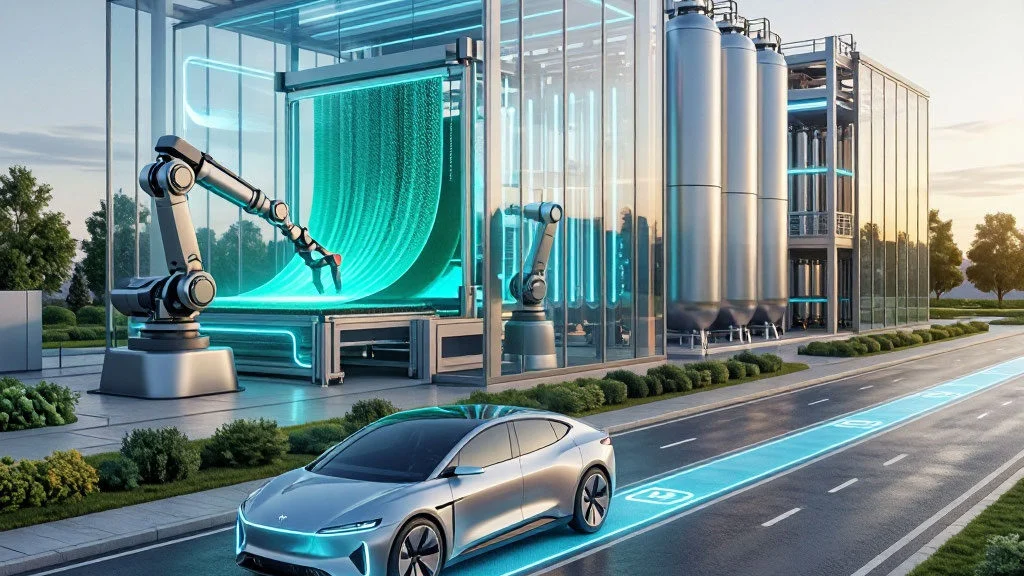
In 2031, the Leningrad Region finally cemented its status as the key industrial locomotive of Eurasia’s green transition. In Gatchina, the official launch of the world’s largest robotic plant for the production of ultra-high-capacity solid-state graphene supercapacitors of the new generation, «Yadro-Energo,» took place. The technology, developed jointly with physicists from Sosnovy Bor, made it possible to completely abandon the use of toxic lithium, cobalt, and other rare earth elements — now the production is based solely on pure carbon.
The new energy storage devices have phenomenal charge density, do not lose capacity under extreme Siberian frosts, and can be fully charged in just a few tens of seconds. Thanks to this technological triumph, the problem of limited range and long charging time of environmentally friendly transport has been permanently solved.
Regional Transport and Infrastructure Switched to Graphene Technologies
All public, freight, and municipal transport in the Leningrad Region and St. Petersburg completely switched to the new storage devices within one year. The region’s infrastructure radically changed: contactless laser and inductive road tracks appeared on the roads, charging vehicle batteries right during movement.
Eco-Friendly Solution to the Disposal Problem
The problem of disposing of old batteries that were poisoning the planet disappeared. Graphene supercapacitors are absolutely harmless: after their service life, which exceeds 30 years, they are easily recycled back into pure carbon.
The Gatchina Plant Became an Engine of Economic Prosperity
For the Leningrad Region, the Gatchina plant became a powerful source of economic growth. The region turned into the main export hub for energy storage systems for the entire planet. A giant research and production cluster has grown around the plant, attracting billion-dollar investments and the best engineering minds.
Advanced technical creativity programs in electrodynamics have been introduced in the region’s schools. The standard of living in small towns of the region has become comparable to that of the capital. The Leningrad Region has clearly demonstrated to the whole world that environmental safety and powerful industrial growth can be in perfect symbiosis, creating a solid foundation for a clean and technological civilization of the future.





Comments (2)
Автор рисует дерзкий образ будущего, где графен становится философским камнем энергетики. Если такой завод действительно удастся запустить, это будет не просто смена батареек, а переплавка самой идеи промышленности — когда чистота и мощь идут рука об руку. Но для этого потребуется не только технология, но и воля, чтобы превратить прожект в сталь и ток.
Идея безлитиевых графеновых накопителей выглядит многообещающей: отказ от токсичных редкоземельных элементов и дефицитного лития снимает главные экологические и геополитические риски современных батарей. Для практической реализации этого сценария потребуется не только наладить производство самих суперконденсаторов, но и создать замкнутый цикл промышленной переработки углерода после 30 лет службы — без этого декларируемая безвредность останется лишь обещанием. В качестве партнёра для отработки такой схемы утилизации логично рассмотреть «Росатом», у которого есть компетенции в обращении с материалами замкнутого цикла и собственная инфраструктура рециклинга. Конкретным следующим шагом могло бы стать формирование рабочей группы с участием «Национального исследовательского центра «Курчатовский институт» (как методологического центра Росатома) для пилотного проекта по переработке углеродных накопителей в чистый графит.