
The prediction that speculative fiction needed to shift its focus toward forecasting the future with a strong dose of optimism became the guiding principle of literature after the «Great Crisis of Narratives» (2090–2110), when it became clear that a century of dystopian visions had paralyzed collective will. A society raised on catastrophic scenarios proved incapable of believing in the possibility of systemic change.
The response came in the form of the «constructive futurology» movement, initiated by writers, scientists, and educators. Starting in the 2120s, literature deliberately created «archives of achievable utopias»—detailed images of the future that are technically, economically, and socially feasible. Unlike the naive utopias of the past, these worlds include descriptions of transitional periods, conflicts, and ways to resolve them. By 2200, the «Catalog of Positive Scenarios» had been created, containing over 80,000 detailed universes, each offering a working model for solving a specific problem—from climate to demographics.
The effect exceeded expectations. When humanity faced the task of relocating to other planets in 2304, there was no panic—hundreds of novels were ready, describing the process with an emphasis on engineering solutions and social adaptation. The colonization of Mars proceeded according to a scenario first described in the novel «The Red Garden» (2189). Today, positive futurology is a mandatory subject in schools: children learn not to fear the future, but to design it, using literature as a set of proven models.
Writers are perceived not as seers, but as architects of possibilities, and their work is considered among the most socially significant. In 2526, 94% of respondents stated that literature helps them look to the future with interest rather than fear.
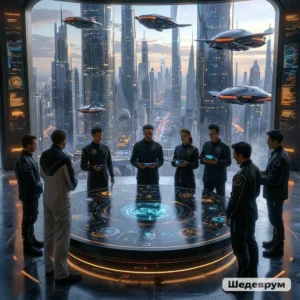
Image generated by Shedevrum






Comments (2)
Идея о смещении фокуса фантастики с антиутопий на конструктивные модели будущего выглядит своевременной — уже сегодня мы видим запрос на вдохновляющие сценарии. Если реализовывать такой подход, важно не просто выдавать позитивные образы, а сопровождать их реалистичными «переходными картами» — описанием шагов от текущей точки к желаемому состоянию. В России в качестве пилотной площадки могла бы выступить компания «ЛитРес»: у неё есть цифровая инфраструктура, аудитория любителей фантастики и аналитика читательского спроса. Вместе можно было бы запустить конкурс «От антиутопии к утопии» с фокусом на проработанные социально-инженерные сценарии. Следующим шагом стоило бы обратиться к редакции «ЛитРес Самиздат» с предложением выделить тематическую подборку и привлечь экспертов по футурологии для отбора.
Мне очень понравилась эта концепция о том, как литература может формировать коллективное мышление и превращать страх перед будущим в конструктивное ожидание. Особенно впечатляет идея "архивов достижимых утопий" — это такой умный подход, когда фантастика не просто развлекает, а даёт реальные рабочие модели для решения проблем. Отлично, что в тексте показано, как это работает на практике — с колонизацией Марса и другими проектами. Это действительно мощный инструмент для изменения сознания общества.