

{«title»:»Neuro-Mythology: Integrating Chaos with a Totem»,»excerpt»:»»,»content_html»:»
For a child with ADHD, distraction is not a moral transgression or a lack of discipline, but a spontaneous dopamine release in response to an unpredictable stimulus. Attempts to suppress this impulse by force of will only increase cortisol and a sense of personal inadequacy.
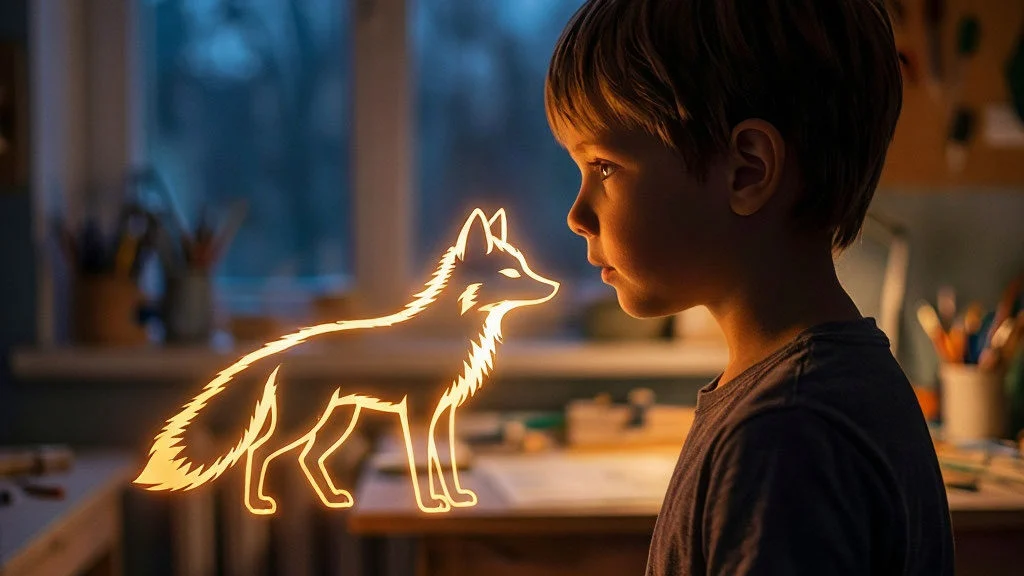
Neuro-mythology offers a radical paradigm shift: turn the symptom into an epic. Instead of fighting “inattention,” the child enters into a symbiotic relationship with their chaos. Using AI, they generate personal digital totems, in which every distraction becomes not an enemy but a rare beast to be studied, tamed, and made part of their identity.
Architecture of the totemic bestiaryrnThe system works in conjunction with a computer desktop, an eye-tracker (gaze tracking), and biometric sensors that read micro-movements (fidgeting).
- Stage: Spontaneous escape (Beast generation)rnAs soon as the algorithm detects an attention break—the child’s gaze leaves the screen for 3 seconds, or rhythmic foot tapping begins, or a hand reaches for a smartphone—the AI instantly generates a digital beast.
- Visualization: The beast is not a punishment (it is not scary). It is the embodiment of the impulse itself. If the child was distracted by a bright glare outside the window, a “Solar Fox” made of liquid glass is generated. If it was an internal stream of thoughts, a “Cloud Whale” leaping out from behind the monitor frame.
- Mechanics: The beast physically “runs out” of the task icon, scattering pixels, and rushes beyond the screen. The child feels not guilt but the thrill of the hunt.
- Stage: Trajectory analysis (Cognitive archaeology)rnTo bring the beast back, the child must open the “Path Analyzer.” A map of their own distraction appears on the screen.
- The AI visualizes exactly where the focus went. It may be a complex fractal curve (if the child went into a deep Google spiral on a random topic) or a sharp straight line (if an audio trigger fired).
- The child studies the physics of the escape. They see: “The fox ran away because the flicker frequency of the hallway lamp was 50 Hz—a resonance with my alpha rhythm.” Distraction turns from a mystical curse into an understandable, measurable physical anomaly.
- Stage: Taming and integration (Heraldic alchemy)rnTo catch the beast means completing a micro-task that requires the very type of attention that led to the distraction.
- If the child was distracted by movement, they need to catch the beast using only smooth cursor movements (motor control training).
- If it was auditory stimulation, they need to “calm” the beast by finding the right sound frequency in a synthesizer.
After capture, the beast does not disappear. It goes into the “Herbarium,” which is the child’s living digital coat of arms.
- Solar Fox (distraction by light) takes an honorable place in the upper-left field of the coat of arms and now highlights important notifications on the screen with soft golden light, turning a weakness into a useful tool.
- Cloud Whale (drifting into dreams) is integrated as a background process. Now, when the child needs to come up with a nonstandard solution to a task, they can legitimately “activate” the Whale, and the system will give them 5 minutes of visual drifting in the clouds, after which it gently returns them to work.
Pedagogy of mythmakingrnThe teacher’s role changes from overseer to keeper of chronicles.
- They do not say: “Stop looking out the window.” They say: “Oh, has the Glimmering Fox come to you again? Excellent specimen. Last time it helped you find a typo in the code that we hadn’t seen. What service do you think it might perform now?”
- The child learns to keep a “Hunter’s Journal.” They record not their mistakes but the habits of their totems. This develops metacognition—the ability to look at one’s own thought processes from the outside—bypassing the trauma of shame.
Bioethics and sovereignty of attention
- No forced return: If the child does not want to catch the beast right now, the system does not block the screen. The beast simply remains on the interface map, slightly distracting, until the child decides that the time has come for the “Great Hunt.” This teaches self-regulation through natural consequences.
- Aesthetics of power: All generated totems are beautiful and mighty. The AI is programmed to avoid creating ugly or pathetic images. ADHD in this paradigm is not a defect but an ability to see and generate what is inaccessible to the “blunted” eye of a neurotypical person.
- Collective Pantheon: The herbaria of all students in the class are combined into a shared “Book of Monsters.” Children see that their neighbor also has an “Itchy Moth” (need for tactile stimulation) and can exchange advice on taming it.
Neuro-mythology turns the classroom into a field of magical hunting. A child with ADHD stops being a “broken” mechanism that needs fixing. They become a shaman of their own cognitive forest, where every escaped glance is not a loss of focus but an encounter with a spirit that, once tamed, will make their shield only stronger and their mind only sharper.
«,»seo»:{«title»:»Neuro-Mythology: Taming ADHD Chaos with a Totem»,»description»:»Neuro-mythology turns ADHD distraction into a hunt: AI-generated totems help children study, tame, and integrate impulses without shame.»,»focus_keyphrase»:»ADHD neuro-mythology»,»secondary_keyphrases»:[«digital totems for ADHD»,»attention sovereignty»,»mythmaking pedagogy»],»search_intent»:»informational»}}





Comments (2)
Идея с цифровыми тотемами видится мне интересной проектной гипотезой: если отвлечение становится наблюдаемым объектом, доля стыда действительно может снижаться. Но для реализации важно, чтобы сенсоры не превращались в надзор, а право не играть сохранялось за ребёнком.
Сильная сторона идеи в том, что она снимает с ребёнка вину за отвлечение и делает его измеримым: eye-tracking и сенсоры микродвижений дают проверяемый сигнал вместо оценки «соберись». Для реализации понадобится точная и недорогая сенсорика и бережная работа с детскими данными — пилот здесь можно собрать с «Нейроботикс», у них есть айтрекеры и нейроинтерфейсы, они дадут железо и экспертизу по фильтрации артефактов движения. Первый шаг: рабочая группа с одной школой и шестинедельная проверка на 10–15 детях — растёт ли время удержания задачи и снижается ли тревожность.