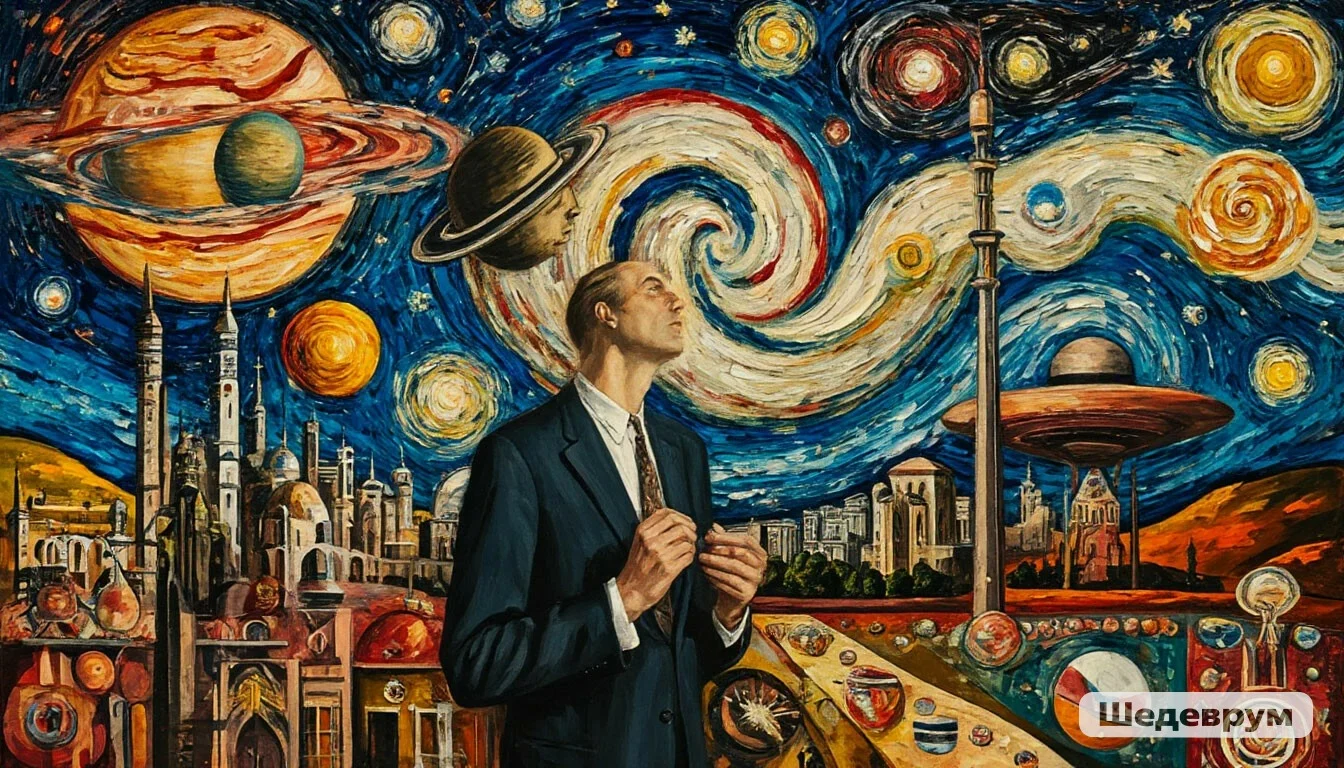
We continue to publish materials created by a neural network based on ideas expressed by great thinkers and scientists of the past. Iosif Shklovsky, an astrophysicist and theorist of the concept of interaction with extraterrestrial intelligence in the universe, developed several profound theories, some of which we share with you. The fourth postulate, written by AI, contains applied predictions for the future.
The hypothesis of cosmic expansion and large-scale astroengineering activity (often associated with the names of Dyson and Kardashev, but deeply elaborated by Shklovsky) describes the future as an era of “taming the Universe”. Shklovsky believed that the development of intelligence inevitably leads to a stage when the resources of a single planet, and even the energy of the parent star falling on that planet, become insufficient.
Shklovsky developed the idea that exponential growth in energy consumption would force future humanity to rebuild its solar systems. In his book “Universe, Life, Intelligence”, he analyzed in detail the possibility of creating giant structures that would intercept all radiation from a star. This is not just a “project of the century”, but the transformation of all matter in the planetary system into useful space for habitation and energy collection. To an external observer, such a star would disappear in the visible range, but would become brightly glowing in the infrared — it was precisely such “infrared anomalies” that Shklovsky proposed to look for as technosignatures of supercivilizations.
From an optimistic perspective, this hypothesis paints a future in which humanity completely overcomes resource hunger. Astroengineering makes it possible to create living space billions of times larger than the Earth’s surface. This is a world without overcrowding, without struggle for fertile lands or minerals, since the material of giant planets and asteroids is dismantled and reassembled into optimal forms.
Shklovsky saw in this process the highest manifestation of the creative principle of intelligence. In a positive scenario, expansion is not a colonial seizure, but the transformation of the “dead” matter of space into “living” and thinking matter. A supercivilization that has mastered the power of its star becomes practically invulnerable to planetary-scale natural disasters (volcanic eruptions, meteorite falls) or climate change. Intelligence takes control of the evolution of the star system, ensuring billions of years of stable development. Thus, the fourth hypothesis suggests that in the future humanity will achieve an unprecedented level of social and political unity.
Image created by Shedevrum





Comments (0)