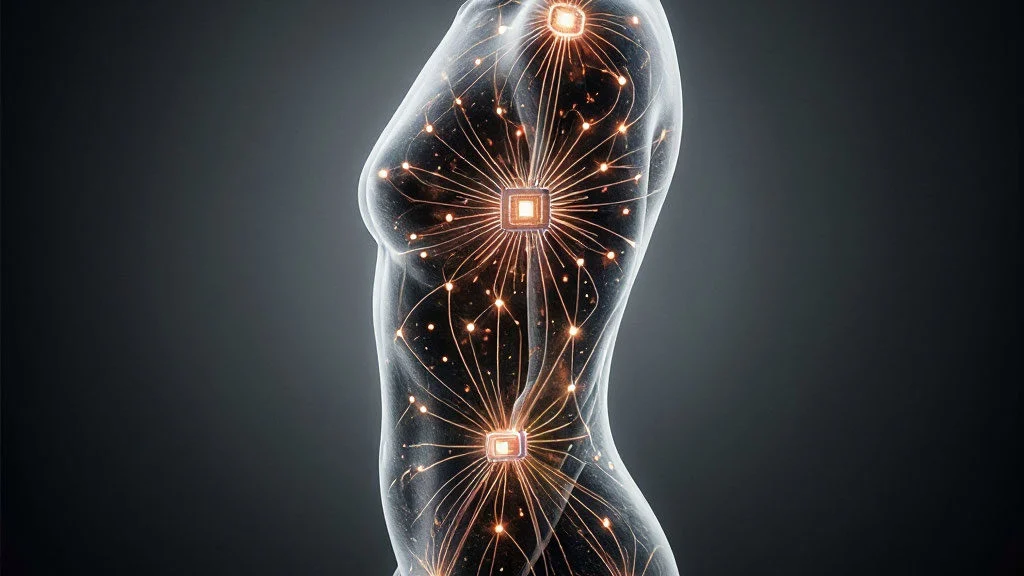

A large-scale stress test of distributed body area networks (BAN) is being deployed with a cohort of one hundred people. Dozens of ECG electrodes, thermometers, and hydration sensors are attached to the bodies of the test subjects. The main feature of the experiment is the rejection of traditional radio frequencies such as Bluetooth or Wi-Fi. Network nodes exchange data through the human body itself, using an extremely low-power electric field (Electro-Quasistatic Human Body Communication). This eliminates signal interception and enormously saves energy, but makes system reliability completely dependent on physical contact between the electrode and the skin.
The participants live in a continuous cycle of physiological stress: they run on treadmills to complete exhaustion, sweat profusely, take hot showers, swim in a pool, and then sleep, tossing and turning and crumpling the sensors. Every circuit break, every millisecond of signal loss due to patch displacement or a salt crust of sweat is logged with microsecond precision.
Statisticians process this data set using survival analysis methods, which are usually applied in insurance or reliability engineering. They construct a survival function $S(t)$ — the probability that electrode-skin contact will remain stable after time $t$ has elapsed.
The key metric becomes MTBF (Mean Time Between Failures)—the average time between failures. However, in the context of living skin, this is not simply an arithmetic mean. Mathematicians calculate MTBF with adjustment for covariates—external factors. Using the Cox regression model, they demonstrate that:
- When sodium chloride concentration in sweat is above 0.9% (intense exertion), contact MTBF falls exponentially because the electrolyte creates an insulating film.
- When relative air humidity is below 20% (dry climate), the patch hydrogel degrades, and the average retention time is halved.
- During REM sleep, when muscles contract chaotically, the probability of chest sensor failure increases fourfold compared with slow-wave sleep.
Manufacturers of smartwatches and medical patches use these survival functions to mathematically justify their claimed accuracy. Instead of a laboratory promise of «99% ECG accuracy,» they can issue a legally significant specification: «The algorithm guarantees QT interval measurement accuracy of 98.5% during continuous wear for 72 hours if the calculated contact MTBF under conditions of 80% humidity and 35°C exceeds 48 hours.»
If survival analysis shows that by the 12th hour of intense exercise the probability of contact loss exceeds a critical threshold, the manufacturer programmatically builds predictive compensation into the algorithm. The neural network begins clearing the signal of noise even before the contact physically degrades, or asks the user to change posture, thereby keeping the accuracy metric within the stated guarantee even under conditions where physics begins to work against electronics.





Comments (1)
Тонкость: MTBF по живой коже нельзя брать как среднее по отказам — нужны цензурированные данные и проверка пропорциональности в модели Кокса, иначе заявленная точность повиснет на узком интервале. Для пилота подошла бы «Медси»: клиники дадут пациентов, врачей функциональной диагностики и площадку. Первый шаг — рабочая группа с их биомедицинскими инженерами и проверка на 20 добровольцах протокола смены электродов при потоотделении. Какой порог потери контакта заложите в критерий остановки?