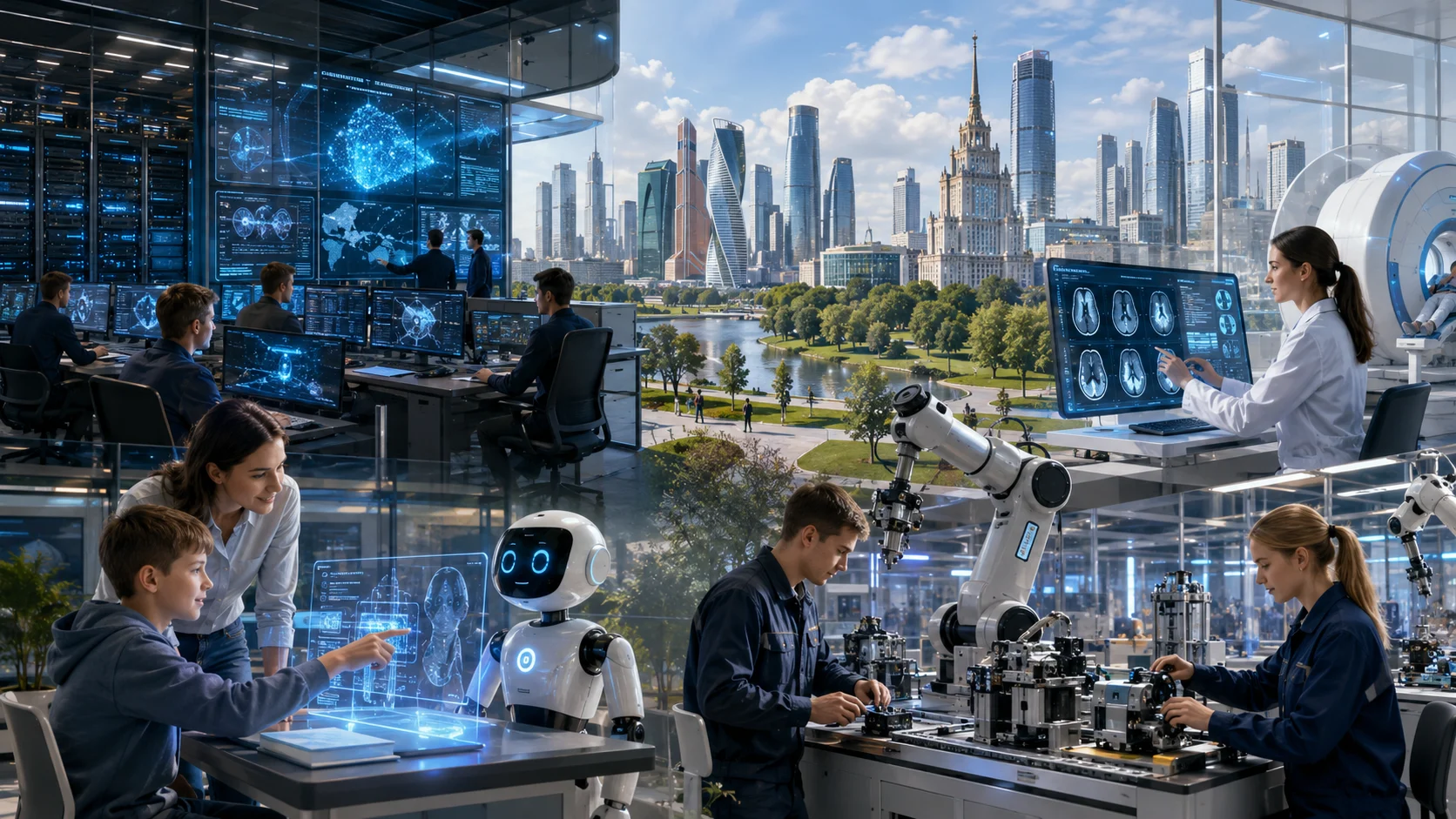
Artificial intelligence begins to serve people
By the early 2030s, a sovereign artificial intelligence ecosystem had emerged in Russia. It did not replace humans but enhanced their abilities: doctors spotted disease risks faster, teachers selected assignments more precisely, engineers modeled complex structures, farmers managed crops with data, and municipalities planned roads, transport, and public amenities based on residents’ actual needs. AI became not a toy for demonstrations but a quiet infrastructure of everyday efficiency.
The key distinction of this ecosystem was its reliance on trust. Data was stored under clear rules, models were validated, algorithms explained their decisions, and humans retained the right to make the final choice. Russia’s languages, culture, communication norms, and regional characteristics were embedded in digital services. As a result, AI did not speak to people in impersonal bureaucratic language but helped solve concrete tasks: process a document, find a doctor, plan a route, prepare a lesson, estimate costs, launch a project.
Trust becomes a key condition for digital growth
The path to this future began with foundational models, computing infrastructure, and secure industry datasets. Then AI entered medicine, education, manufacturing, agriculture, transport, and public services. The next stage was the creation of algorithm validation centers, where accuracy, ethics, robustness, and usefulness were assessed. After that, regions began building their own applied teams: some developed AI for tourism, others for logistics, and still others for housing and utilities, ecology, or workforce forecasting.
Ordinary people participated in AI development not as passive users. They learned to formulate requests, verify answers, protect personal data, and use neural networks for work and creativity. Teachers explained digital responsibility to students, doctors provided feedback on services, entrepreneurs automated routine tasks, and authors on Futurating described ideas where AI helped people become stronger, not less visible.
Futurating became a platform for public design of such an ecosystem. Users created postulates about medical AI, smart cities, education, digital assistants, ethics, and new professions. The platform made it possible to assess not only probability but also contribution: who is ready to collect data, who will train people, who will test the service, who will explain its benefits to society. In this way, artificial intelligence was embedded in a vision of the future where technology served humanity.









Comments (0)