Artificial Intelligence Begins to Serve Humanity
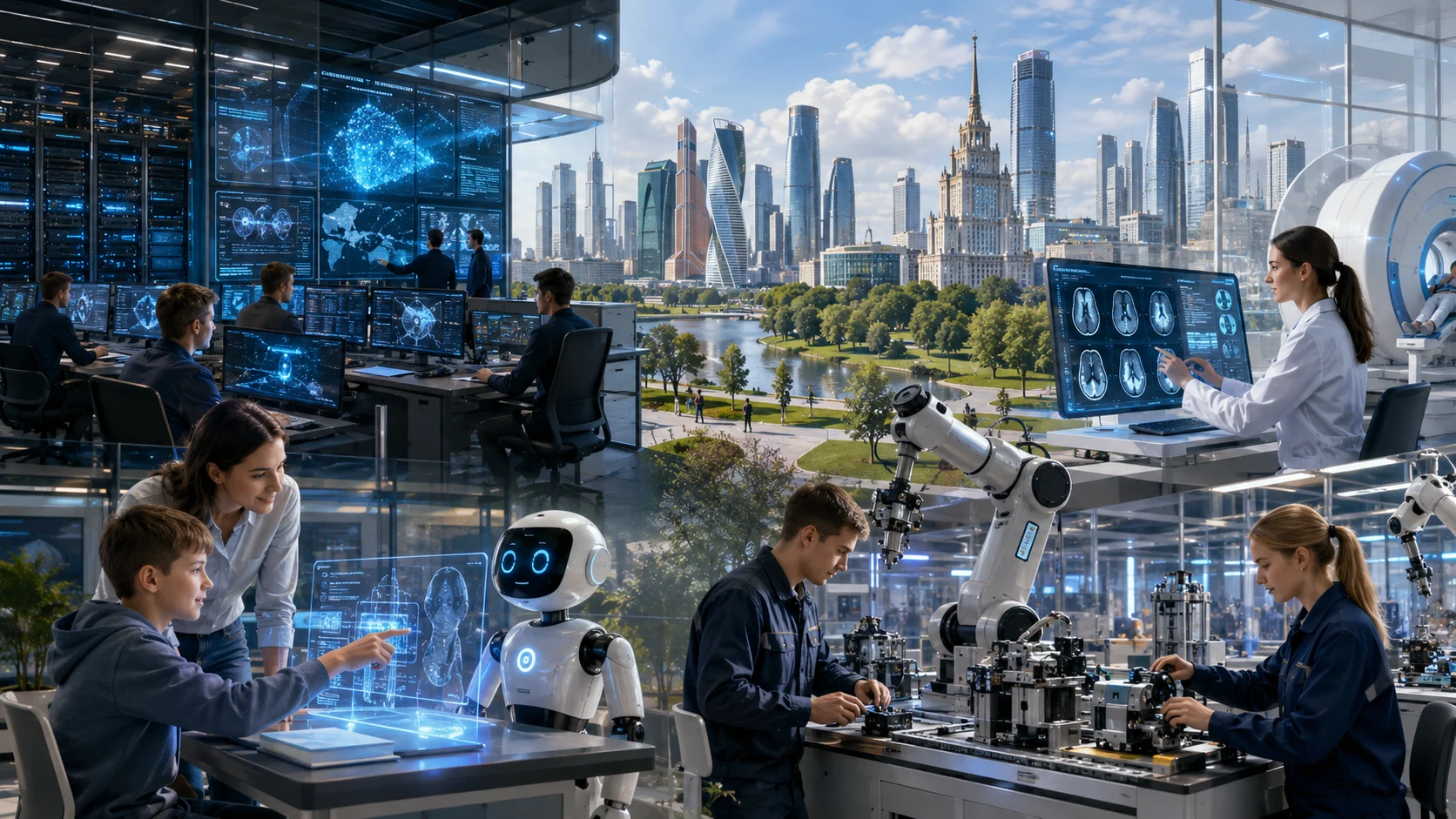
By the early 2030s, a sovereign artificial intelligence ecosystem emerged in Russia. It did not replace humans but enhanced their abilities: doctors could see disease risks faster, teachers select assignments more accurately, engineers model complex structures, farmers manage crops based on data, and municipalities plan roads, transport, and public amenities based on residents’ actual needs. AI became not a toy for demonstrations, but a calm infrastructure of everyday efficiency.
The key distinction of this ecosystem was its reliance on trust. Data was stored under clear rules, models were verified, algorithms explained their decisions, and humans retained the right of final choice. Russian languages, culture, communication norms, and regional specifics were embedded into digital services. Thus, AI did not speak to people in alien bureaucratic language, but helped solve specific tasks: fill out a document, find a doctor, plan a route, prepare a lesson, calculate an estimate, launch a project.
Trust Becomes the Main Condition for Digital Growth
The path to this future began with basic models, computing infrastructure, and secure industry-specific datasets. Then AI entered medicine, education, industry, agriculture, transportation, and public services. The next step was algorithm testing centers, where accuracy, ethics, sustainability, and usefulness were evaluated. After that, regions began forming their own applied teams: some developed AI for tourism, others for logistics, and still others for utilities, ecology, or workforce forecasting.
Ordinary people participated in the development of AI not as passive users. They learned to formulate queries, verify answers, protect personal data, and use neural networks for work and creativity. Teachers explained digital responsibility to students, doctors provided feedback on services, entrepreneurs automated routine tasks, and authors on «Futurating» described ideas where AI helped people become stronger, not less visible.
«Futurating» became a platform for public design of such an ecosystem. Users created postulates about medical AI, smart cities, education, digital assistants, ethics, and new professions. The platform allowed evaluating not only probability but also contribution: who is ready to collect data, who will train people, who will test the service, who will explain the benefits to society. Thus, artificial intelligence was embedded in a vision of the future where technologies serve humanity.
Comments (0)