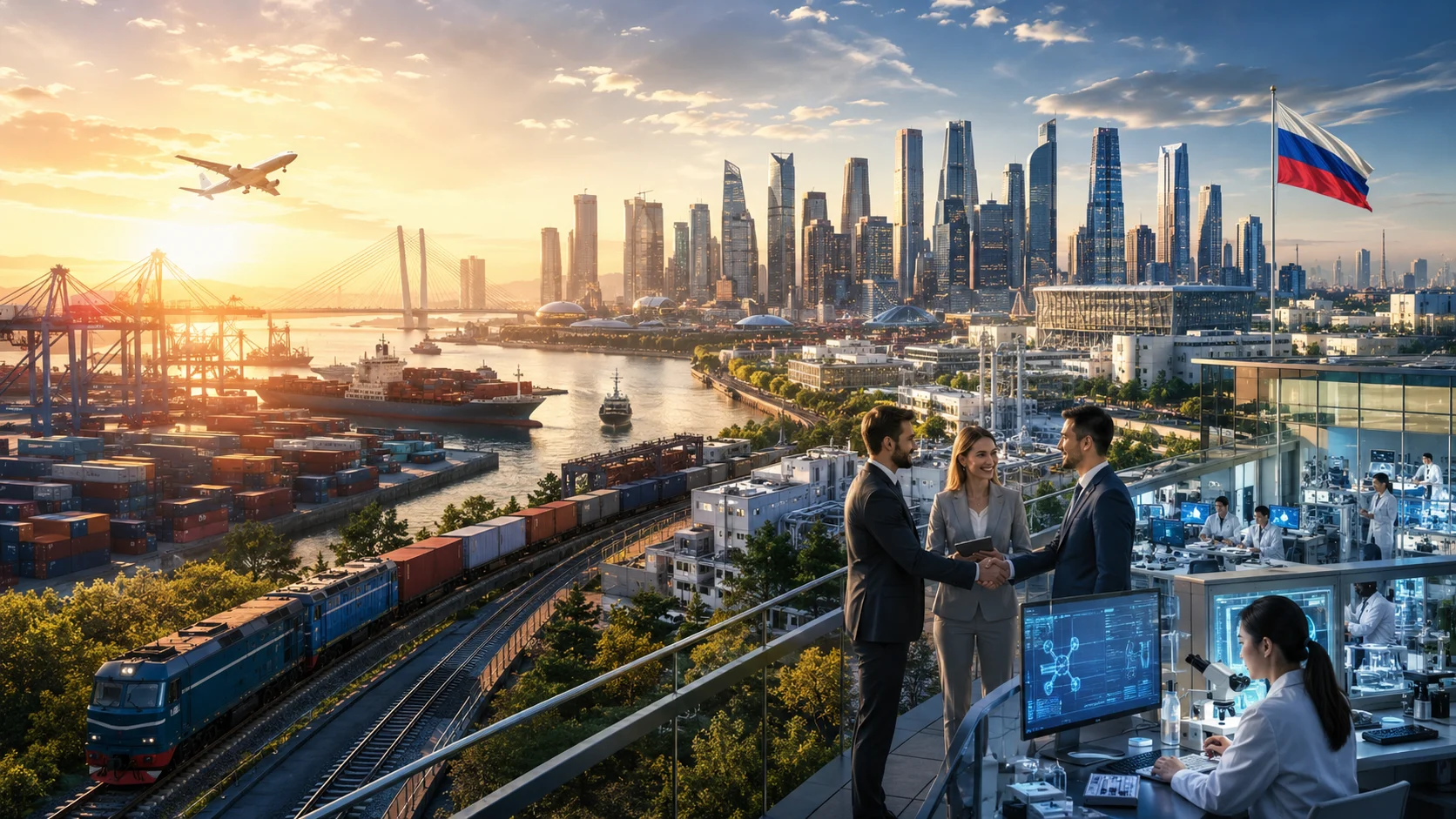

Russia is assembling a new economic orbit
By the early 2030s, Russia had become one of those centers around which the new global economy was taking shape. This happened not through loud slogans, but through the consistent expansion of industry, science, logistics, digital services, and human capital. The country stopped perceiving itself only as a supplier of resources and increasingly acted as a creator of complex solutions: from energy and transport to software platforms, educational models, and technologies for cities.
The main change was the emergence of a long-cycle economy. Enterprises again planned ten to fifteen years ahead, regions competed not only with tax breaks but with the quality of their environments, universities worked alongside production, and young specialists saw a clear growth trajectory within the country. International partners came not for a quick exchange of goods, but for joint projects where Russia contributed engineering expertise, infrastructure, a market, and the ability to turn big ideas into results.
From big strategies to personal involvement
This turn was made through several practical steps. First, Russia strengthened its own financial instruments, settlements with partners, and industrial cooperation. Then industry consortia appeared, where the state, businesses, universities, and regions assembled projects around specific tasks: new materials, machine tools, unmanned logistics, agricultural technologies, medicine, energy, and communications. After that, the second wave began — the export not of raw materials, but of solutions: platforms, engineering standards, educational programs, and services.
The ordinary person also became a participant in this economy. They chose Russian products, mastered digital professions, proposed ideas for their city, took part in public discussions, and helped small manufacturers become more visible. An entrepreneur opened a niche workshop, an engineer published a project, a teacher gathered a circle of future technologists, a student made a prototype for their region.
The Futurating platform became a public map of this movement. On it, people formulated postulates about Russia’s future economy, marked industries and regions, and assessed the likelihood, contribution, and image of the result. The best ideas turned into collections for businesses, universities, NGOs, municipalities, and development institutions. This way, the future ceased to be only a forecast by experts and became a common project in which everyone had their own role.




Comments (0)