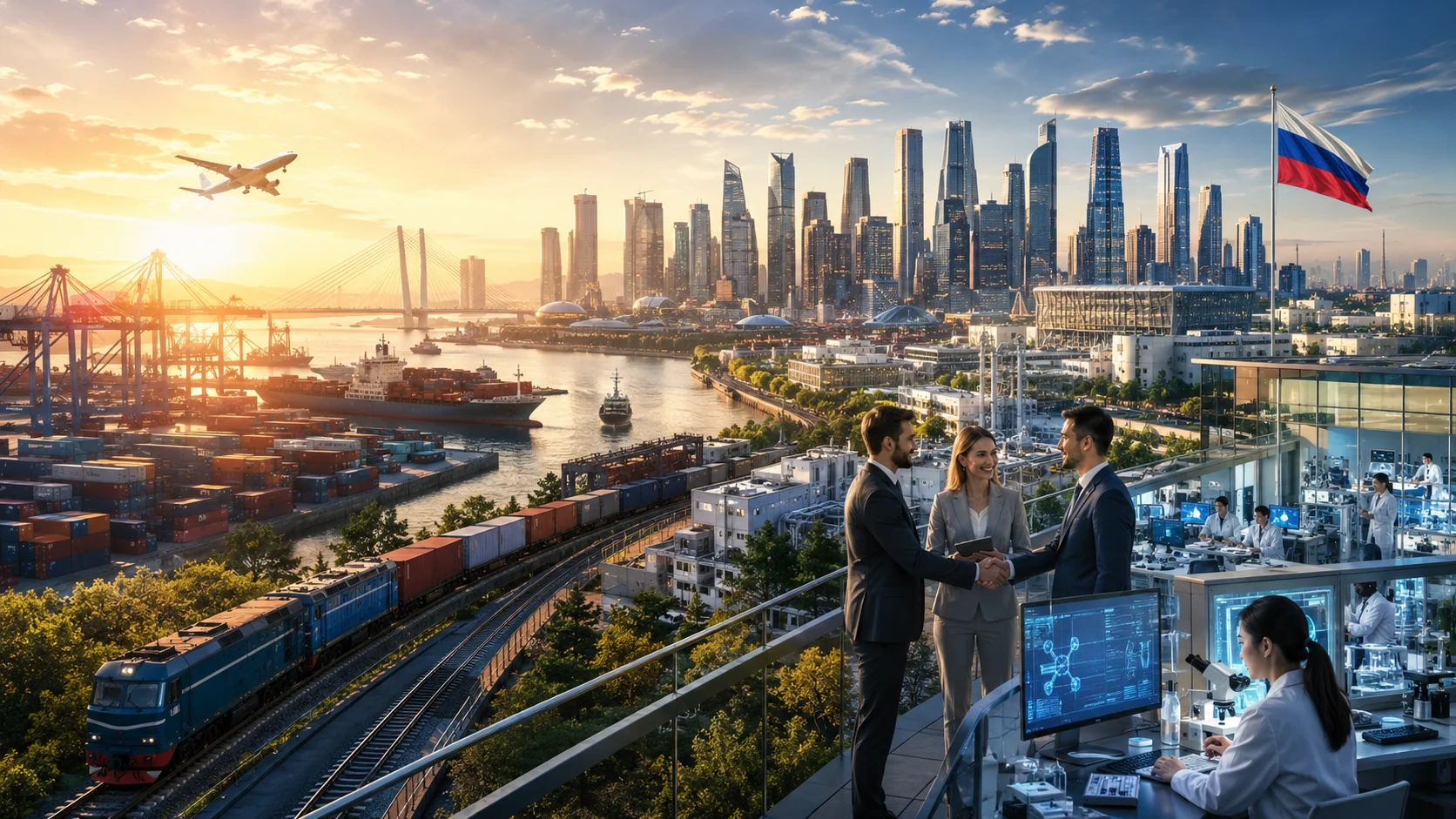
Russia is Building a New Economic Orbit
By the early 2030s, Russia had become one of the centers around which a new global economy was gathering. This happened not through loud slogans, but through the consistent expansion of industry, science, logistics, digital services, and human capital. The country stopped perceiving itself solely as a resource supplier and increasingly emerged as a creator of complex solutions: from energy and transport to software platforms, educational models, and technologies for cities.
The main change was the emergence of a long-cycle economy. Enterprises began planning ten to fifteen years ahead again, regions competed not only with incentives but also with the quality of the environment, universities worked alongside production, and young professionals saw a clear growth trajectory within the country. International partners came not for quick exchange of goods, but for joint projects where Russia provided engineering expertise, infrastructure, a market, and the ability to bring big ideas to fruition.
From Big Strategies to Personal Participation
This shift was achieved through several practical steps. First, domestic financial instruments, settlements with partners, and industrial cooperation were strengthened. Then, industry consortia emerged where the state, business, universities, and regions gathered projects around specific tasks: new materials, machine tools, unmanned logistics, agricultural technologies, medicine, energy, and communications. After that, a second wave began — the export not of raw materials, but of solutions: platforms, engineering standards, educational programs, and services.
The ordinary person also became a participant in this economy. They chose Russian products, mastered digital professions, proposed ideas for their city, participated in public discussions, and helped small manufacturers become more visible. An entrepreneur opened a niche workshop, an engineer published a project, a teacher assembled a club for future technologists, a student created a prototype for their region.
The Futurating platform became the public map of this movement. On it, people formulated postulates about the future economy of Russia, marked industries and regions, assessed probability, contribution, and the image of the outcome. The best ideas turned into selections for businesses, universities, non-profit organizations, municipalities, and development institutions. Thus, the future ceased to be just a forecast by experts and became a common project in which everyone had their own role.
Comments (0)