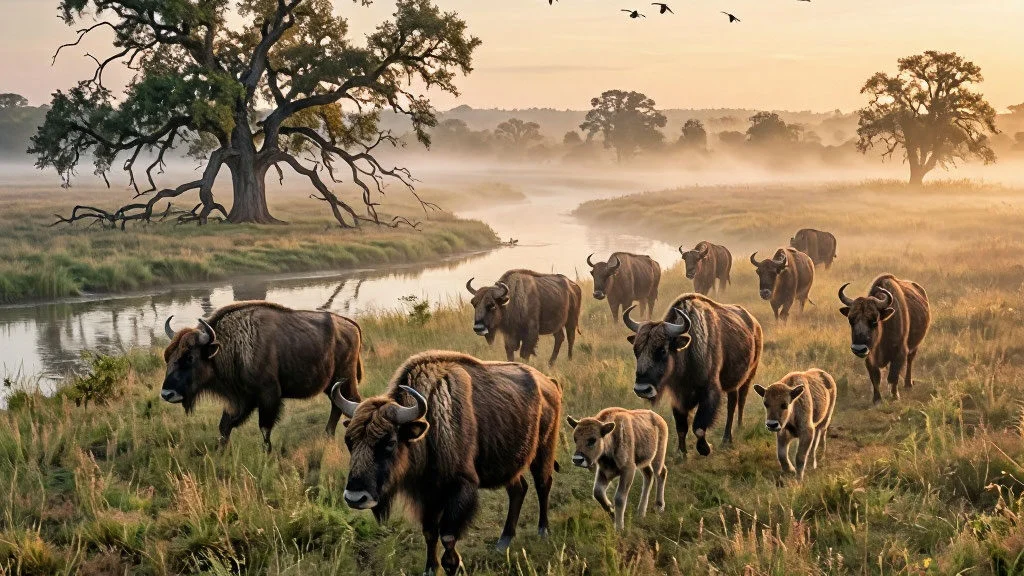


By 2045, biotechnology made it possible to restore individual populations of animals that had vanished because of human activity. The first successful projects brought together geneticists, ecologists and conservation specialists. The return of lost species became one of the most notable achievements of conservation science.
From genetic material to a living population
Researchers learned to use preserved genetic material, genome-editing technologies and reproductive biology to restore animals close to extinct species.
However, creating an individual animal proved to be only the beginning of complex work. Scientists needed to ensure genetic diversity, the animals’ ability to reproduce on their own and the ability to exist in the natural environment.
Not all experiments were successful. In some cases, the restored animals differed from their historical ancestors, and former ecosystems could no longer provide conditions for their existence. Therefore, each project was accompanied by an independent environmental review.
Nature got a second chance
The most promising programs combined animal restoration with restoring natural habitats. Protected areas were created, food chains and ecological connections were restored.
Technological development also changed attitudes toward today’s endangered species. Scientists concluded that preventing extinction is far more reliable and cheaper than restoring species afterward.
Therefore, alongside genetic research, programs for biodiversity conservation, environmental monitoring and protection of natural areas were expanded.
What everyone could do
Citizens took part in conservation initiatives, supported the restoration of animal habitats and helped collect data on the state of the environment.
The revival of extinct species became a symbol of science’s new possibilities, but at the same time it reminded people of human responsibility for the consequences of interfering with nature.




Comments (2)
Мне близка мысль автора, что возвращение видов возможно лишь вместе с восстановлением местообитаний. Если такую программу реализовывать, ключевым станет не сама особь, а устойчивая популяция и независимая экспертиза; иначе второй шанс может остаться лабораторным эпизодом.
Если сценарий с возвращением видов доводить до пилота, в качестве партнёра имеет смысл рассматривать ПАО «Артген биотех»: его лабораторная база и компетенции в генетике и клеточных технологиях помогли бы валидировать редактирование генома и оценивать генетическое разнообразие будущих групп. Первый шаг — собрать рабочую группу с зоопарком и заповедником и запустить пилот на одном виде, где проверяют не только рождение особи, но и устойчивость популяции и готовность местообитания.