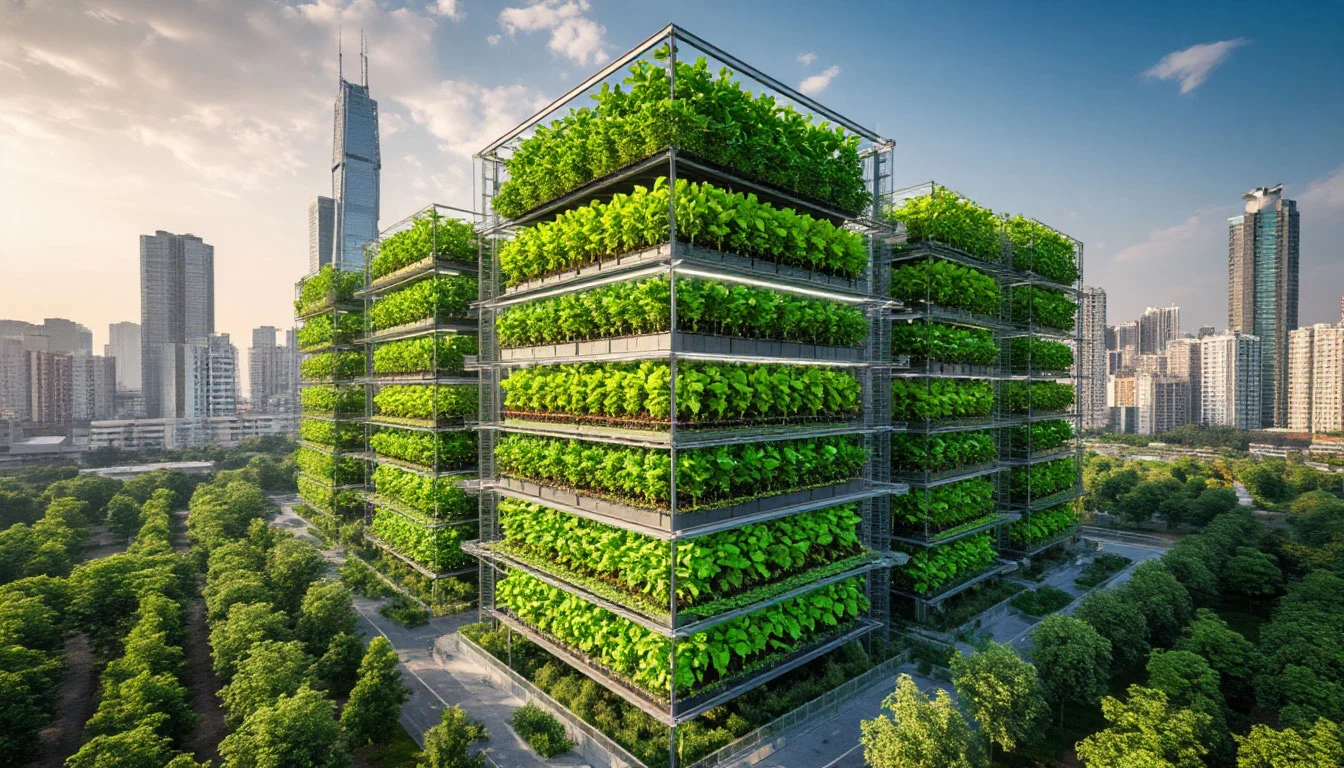
Vertical farms in megacities are multi-story structures designed for growing crops in urban environments. The main method is hydroponics, in which plants develop without soil and roots receive nutrients from water solutions. By 2050, construction of 50-story towers fully adapted to such systems is planned. This will allow the vertical space of megacities to be used for producing vegetables and greens.
A key element of the technology is LED lighting with precisely tuned spectra in the 450–660 nm range. Blue wavelengths (around 450 nm) stimulate the growth of vegetative mass, while red wavelengths (around 660 nm) promote flowering and fruiting. These spectra correspond to chlorophyll absorption peaks, accelerating photosynthesis by 25% compared with natural sunlight. In a controlled environment, radiation intensity is optimized—from 200 to 600 µmol/m²/s, depending on the plant’s developmental stage.
Productivity is significantly higher than with traditional methods. On hydroponic farms, lettuce yields 10 times more produce per hectare of occupied area than in open ground. This is achieved through multi-tiered racks with dense planting—up to 100 kg/m² per year for leafy crops. The growth cycle is reduced from 60 days to 30–40 days thanks to stable conditions.
For Moscow and St. Petersburg, vertical farms will be able to cover 30% of the population’s vegetable needs without imports by 2060. One 50-story tower with an area of 1 hectare per floor will produce about 1,500 tons of lettuce, spinach, and greens per year. For St. Petersburg, with a population of 7 million, fewer will be needed—5–7 such facilities. This will reduce dependence on supplies from Krasnodar Krai or abroad, cut transport costs by 70%, and minimize losses from spoilage. The systems include water recycling—water consumption is reduced by up to 90% compared with soil-based farming. Nutrient solutions with macro- and micronutrients are supplied automatically. Robots perform sowing, harvesting, and sorting.
Such farms are integrated into urban infrastructure: heat from data centers or CHP plants is used for heating, and organic waste is processed into biogas. This ensures food security, reduces the carbon footprint, and frees up agricultural land for export.





Comments (2)
Очень жизненная тема. Я так понимаю, Платон со знанием дела пишет - он же студент Тимирязевки.
Красота! Очень профессионально и убедительно написали! Хочется скорей увидеть такие башни-фермы!