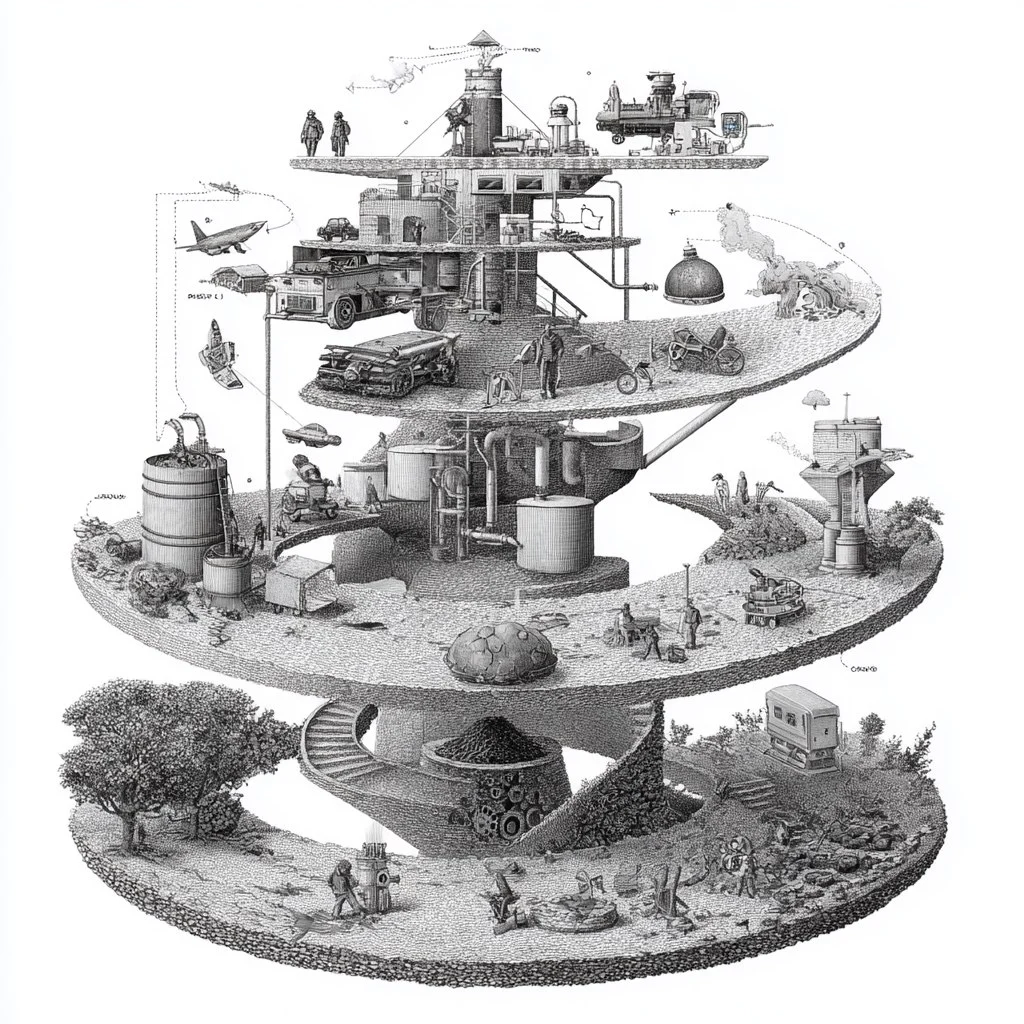
The era of the colonial economy, where Russia’s role was reduced to a supplier of raw materials for other countries’ technological chains, has finally ended!
A legislative ban was adopted on the export of any resources in unprocessed form. This became not a barrier but an assembly point for a new economy, where Russia’s main export commodity was not raw materials but complex, highly sought-after products created by the intellect of domestic engineers and workers.
The foundation of the breakthrough was a strategic audit conducted by a consortium of Russian scientists and economists—staff of the new Ministry of Added Value. They studied global demand for components and end products that could potentially be made from our raw materials and identified points of focus—those industries and segments where added value and return on investment were highest. This made it possible not to scatter resources but to implement the principle of precise and ultra-successful entry into global markets.
The construction of modern plants and production clusters was not chaotic but strictly ordered by this algorithm of benefit. The first phases—mid-stream production facilities such as catalysts, polymer granules, and specialized alloys—provided fast financial returns. This profit, in turn, was not diverted into the speculative sector but became fuel for the next, more complex iteration. Thus, a self-reproducing development cycle was launched: profits from simpler processing stages financed breakthroughs in high-tech ones, creating a continuous upward spiral of added value.
The former ‘raw materials appendage’ has transformed into a global intellectual hub. Instead of gas, we now sell revolutionary polymers and products made from them; instead of timber—modular eco-cities with wood composites of new strength; instead of metals—complex components for the world’s fusion and space programs, reactors, rockets, aircraft.
The efficiency of this model increased thanks to the replacement of many import items with our own products.
Thus, a strategy of genuine sovereignty was implemented, based not on the possession of resources but on their transformation. The subsoil and non-renewable resources were carefully preserved for future generations as an insurance fund for the application of their intellect and creativity.
When common sense acquired the force of Law, the historical gap between the country’s wealth and the well-being and life success of its citizens was quickly overcome.







Comments (0)