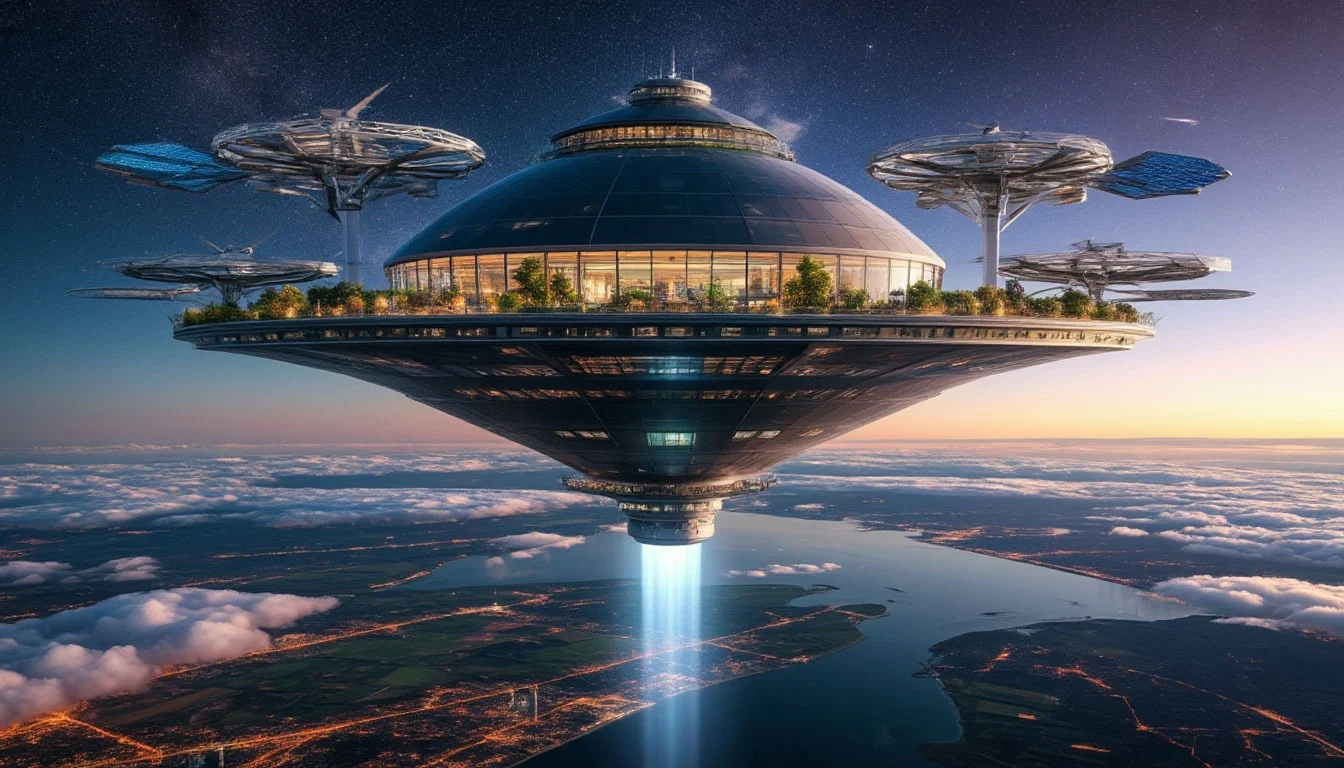
Instead of flying somewhere, you can ascend into the stratosphere, where giant platforms host gardens, pools, and observatories with views of Earth’s curvature.
The science behind it: aerostatic platforms made of graphene composites, held aloft by autonomous wind turbines and solar panels. They become stationary “cities in the clouds,” accessible for the price of a regional flight ticket. This makes it possible to observe the northern lights from above or spend days in reduced gravity without rockets.
Floating Gardens: Stratospheric Tourism
By the mid-21st century, the travel paradigm had shifted. Instead of crossing oceans, humanity learned to rise above them. The idea of “floating cities” ceased to be a utopia and materialized as giant stratospheric platforms. These colossal structures, drifting at altitudes of 20–30 kilometers, became a new symbol of luxury and an affordable form of recreation, turning into stationary “cities in the clouds” that can be reached for the price of a regional airline ticket.
The scientific basis of this marvel is a breakthrough in materials science and energy. The platforms are gigantic aerostats whose envelopes are made of graphene composites. This material offers unique strength at nearly zero weight, allowing entire complexes—including infrastructure for hundreds of guests—to be held in the air. Energy autonomy is achieved by covering the platform surfaces with highly efficient solar panels and using autonomous wind turbines, which not only generate electricity but also serve as an active positioning system, keeping the platform at a designated point through micromaneuvering.
The interior of these flying islands is transformed into a paradise garden. Parks with exotic plants are laid out, heated pools operate, and restaurants open with panoramic views of the blackness of space and the dazzlingly bright curvature of Earth. The main attraction is the observatories, located above 99% of atmospheric water vapor, allowing astronomical observations and aurora viewing with unprecedented clarity.
In addition to aesthetic pleasure, stratospheric tourism offers a unique physiological experience. At such altitudes, gravity is slightly but perceptibly lower than on Earth, and hypobaric conditions create the effect of “terrestrial space.” This allows tourists to undergo acclimatization to conditions similar to Martian ones, or simply experience the lightness of being without having to leave the planet’s atmosphere on a rocket. Humanity has found a way not to fly to the stars, but to bring a piece of the starry sky and weightlessness back home, suspending it at the edge of the atmosphere.




Comments (1)
Это звучит как настоящее чудо — подняться над облаками, не покидая атмосферу, и любоваться Землёй с высоты, где гравитация чуть слабее. Особенно впечатляет идея обсерваторий над 99% водяного пара! Интересно, а каким образом поддерживается комфортная температура внутри парящих садов при такой высоте и перепадах?