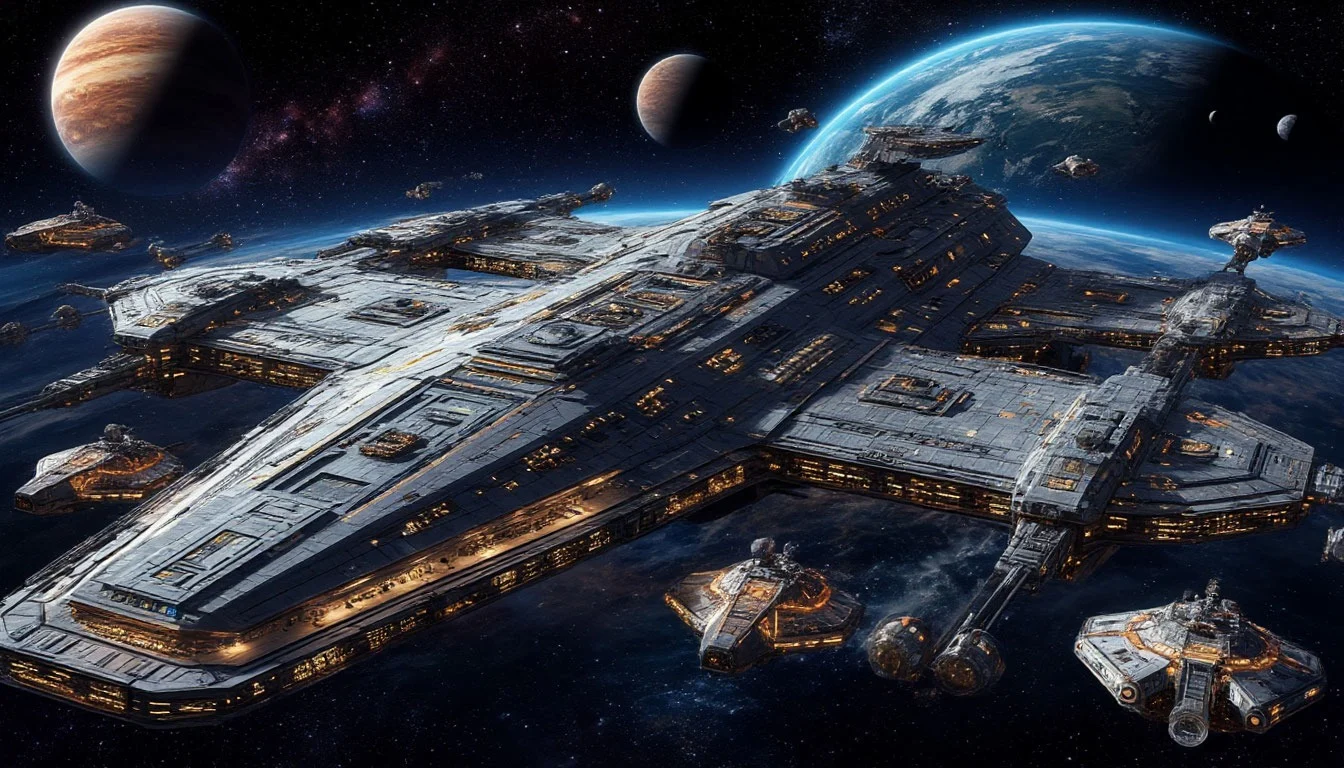
Traditional classrooms will disappear, giving way to educational journeys aboard interstellar ships. This concept represents the culmination of a shift from theoretical learning to applied research, where the entire universe becomes a classroom. The curriculum will be built around real research: students will study astrophysics, geology, and xenobiology by analyzing exoplanets and deep-space anomalies in the field.
In this model, the interstellar ship acts not merely as transportation but as a comprehensive educational ecosystem—a symbiosis of a research laboratory, an engineering testing ground, and a living module. The program ceases to be linear and predictable, transforming into a dynamic map that reshapes itself according to the route and cosmic discoveries.
- Astrophysics is learned not from textbooks but through real-time observation of a star’s collapse, calculating gravitational distortions based on data from the ship’s external sensors.
- Geology and planetology become hands-on practice: students land on an exoplanet’s surface to compile its geological history by analyzing atmospheric composition and seismic activity.
- Xenobiology turns from theory into an exciting reality, where the detection of biosignatures becomes the central event of the semester, requiring immediate analysis in the field laboratory.
In these conditions, the mentor acts as a coordinator of interdisciplinary research, a strategist, and a keeper of knowledge, while the student serves as a full-fledged crew member and an active scientist. Responsibility for research outcomes becomes absolute, demanding the highest psychological flexibility and the ability to work in a team under extreme conditions. Education is no longer preparation for life but becomes life itself—a continuous process of discovery, where knowledge is born from personal experience at the forefront of human capability.





Comments (1)
Идея обучения через прямое включение в реальные космические исследования — мощный сдвиг от симуляции к настоящему опыту. Если такой подход реализовать, ключевым элементом станет не транспорт, а замкнутая образовательная среда, где каждый модуль корабля работает как лаборатория. Для отработки этой концепции на Земле интересно было бы привлечь «Роскосмос»: у них есть центр подготовки космонавтов с гидролабораторией и центрифугой, а также опыт автономных экспериментов на МКС. Именно их инфраструктура и наработанные методики длительных изоляционных исследований могли бы стать полигоном для симуляции экспедиционного обучения. Следующий шаг — собрать рабочую группу из методистов МФТИ и инженеров ЦПК имени Гагарина, чтобы спроектировать недельный пилотный модуль, в котором студенты решают настоящую научную задачу — например, поиск биосигнатур в замкнутой экосистеме, — без доступа к внешней сети.