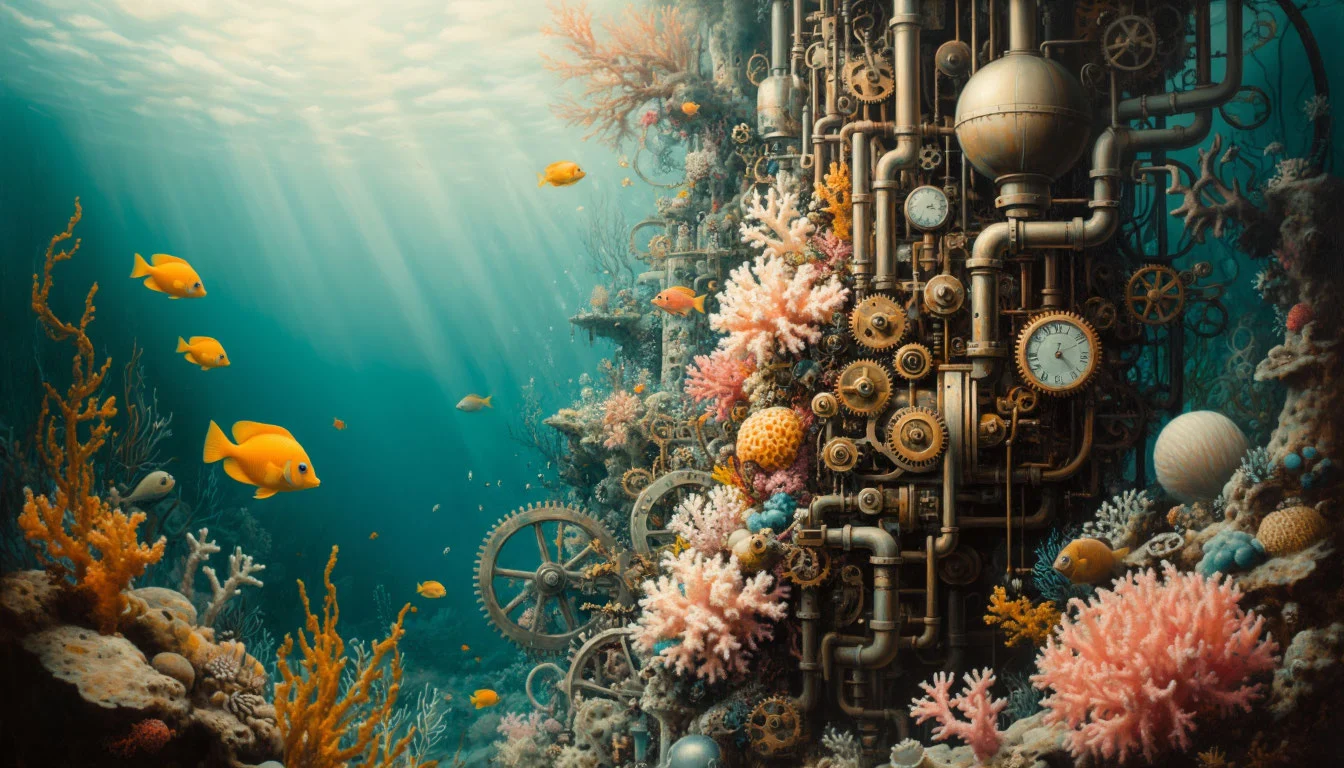

By 2055, bioengineered coral farms will revolutionize ocean agriculture, creating symbiotic ecosystems where CRISPR-modified corals will accelerate the growth of edible mollusks and plankton, providing 15% of global protein without competition with land. Modern reefs, bleaching due to warming (a rise of 1.1°C increases acidity by 30%, dissolving calcium carbonate), will become the foundation for «living farms». Genetically edited coral reefs will grow 10 times faster (from 5 cm/year to 50 cm), filtering water and producing 100 kg of protein per hectare per year — mussels, oysters, and spirulina with 70% protein.
Technologies are already being tested: the Reef Restoration Foundation project has been using microfragments since 2017 to restore 14,000 km² of reefs, and DARPA’s BDM plans genetically resilient barriers. In farms, underwater modules — 3D-printed reef frameworks made of bioplastic — are seeded with spores, where mollusks (Pinctada margaritifera) accumulate omega-3, and plankton (Nannochloropsis) ferments lipids. AI drone swarms (like Saildrone) monitor pH, temperature, and biomass via hyperspectral imaging, adjusting nutrition (nitrogen from ammonia by Nitrosopumilus bacteria). The harvest is collected by soft robot crabs, minimizing turbulence.
The economy will take off: a hectare of farm pays for itself in a year at $10/kg of plankton, exports to China/EU — $500 billion/year. Russia will develop the Sea of Okhotsk (reserves of 500,000 tons of mollusks), integrating with aquaculture. Risks — invasiveness — are neutralized by sterile strains and geofencing. Biodiversity will increase: farms will boost fish schools by 40%, solving the protein deficit for 9.7 billion people. The goal is ambitious but achievable.
Image generated by Shedevrum








Comments (0)